Advances in Engineering Advances in Engineering features breaking research judged by Advances in Engineering advisory team to be of key importance in the Engineering field. Papers are selected from over 10,000 published each week from most peer reviewed journals.

Significance
Recently, rechargeable lithium-ion batteries have attracted significant interests among researchers owing to their excellent properties including high energy density and long lifespan. Besides, global emphasis on sustainable developed has further increased the potential application of lithium-ion batteries in various fields such as electric vehicles. Unfortunately, the current technology cannot meet the requisite amount of energy for such applications. Generally, electrode materials for reversible electrochemical processes determine the energy density of the lithium-ion batteries. Thus, there is a great need for high capacity anode material to enhance lithium storage performances.
Presently, transition metal oxides especially cobalt oxide has been identified as a promising solution for high energy storage capacity materials for enhancing the performance of rechargeable lithium-ion batteries. For electrochemical lithium storage, however, cobalt oxide results in poor rate capability and cycling stability during repeated charge-discharge cycles. To this note, cobalt oxide materials with different morphologies like nanotubes have been synthesized using rational structural design. However, constructing microscale and nanoscale dimensions for overcoming electrode pulverization during charging and discharging cycles have remained a challenge. This is attributed to the fragile nature of nanoscale building blocks that may easily get damaged thus leading to poor capability rate and cyclability. Therefore, researchers have been looking for alternatives to develop effective cobalt oxide materials exhibiting high capability rate, specific capacity, and cyclability.
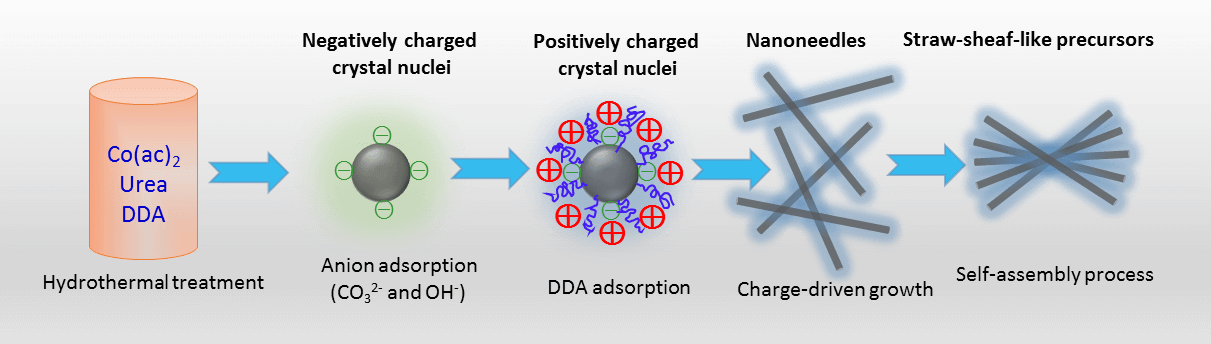
A group of researchers led by Dr. Chi-Wing Tsang and Dr. Xiao-Ying Lu at Technological and Higher Education Institute of Hong Kong synthesized straw-sheaf-like cobalt oxide composed of many strongly tied nanoneedle by a charge-driven self-assembly method. The synthesis was implemented in the presence of diallyldimethylammonium chloride followed by subsequent heat treatment in air. Through repeated charge-discharge cycle, they investigated physical characteristics, rate capability, specific capacity and cyclability of the synthesized sheaf-like cobalt oxide as anode material for electrochemical lithium storage. Their main aim was to improve electrochemical lithium storage targeting at enhancing the performance of rechargeable lithium-ion batteries. The work is published in Chemical Engineering journal.
The authors observed that when straw-sheaf-like cobalt oxide was used as anode material for electrochemical lithium storage, superior cycling stability, high specific capacity, and excellent capability rate were achieved efficiently during repeated charging and discharging cycles. Consequently, through material characterization, it was noted that the nanoneedles exhibited typical length and the average diameter of 10µm and 80nm respectively. Furthermore, the formation of straw-sheaf-like structures was highly influenced by positively charged diallyldimethylammonium chloride molecules.
The study is the first to employ charge-driven self-assembly technique for clarifying the growth mechanism of straw-sheaf-like structures. Thus, it led to successful synthesis and demonstration of sheaf-like cobalt oxide in electrochemical lithium storage by repeated charging and discharging cycles. Based on the obtained results, the synthesis strategy proposed will be a key consideration in developing electrode materials for high-performance energy storage materials which will thus enhance the efficiency and performance of next-generation rechargeable lithium-ion batteries.


Reference
Wang, B., Lu, X., Tsang, C., Wang, Y., Au, W., Guo, H., & Tang, Y. (2018). Charge-driven self-assembly synthesis of straw-sheaf-like Co3O4 with superior cyclability and rate capability for lithium-ion batteries. Chemical Engineering Journal, 338, 278-286.
Go To Chemical Engineering Journal