Advances in Engineering Advances in Engineering features breaking research judged by Advances in Engineering advisory team to be of key importance in the Engineering field. Papers are selected from over 10,000 published each week from most peer reviewed journals.

Significance Statement
The use of transition-metal nanoparticles such as copper nanoparticles during catalysis is of interest due to the high surface area and desired particle size it possesses. However, their use in reaction catalysis has not yet been explored.
Professor Reinout Meijboom and Dr. Matumuene Joe Ndolomingo from University of Johannesburg in South Africa determined the surface area and particle size of supported copper nanoparticles while using organothiol adsorption-based technique. The prepared copper nanoparticles were synthesized with two supports; γ-Al2O3 and Li2O/γ-Al2O3 while 2-mercaptobenzimidazole 2- was used as the probe ligand. The work was published in the journal, Applied Surface Science.
The authors found that the added support on copper nanoparticles initiated the adsorption of 2-mercaptobenzimidazole. The rate of adsorption for the probe ligand used was higher in cases of copper nanoparticles supported with Li2O/γ-Al2O3 compared with that of γ-Al2O3 supports. As the rate of concentration of 2-mercaptobenzimidazole increases, adsorption on the copper nanoparticles decreases, and as a result, increase of organothiol concentration of the copper nanoparticles became saturated, suggesting the completion of organothiol molecule assembly on the copper nanoparticles.
While using the same technique they calculated the packing densities of 2-mercaptobenzimidazole on supported copper, gold, platinum and palladium nanoparticles. The calculated saturation capacity of the 2-mercaptobenzimidazole on the selected metal nanoparticles when compared to other analytical methods correlated well, validating the chemisorption technique used in this study.
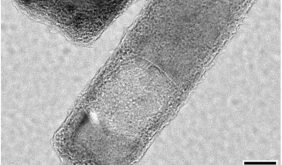
The Langmuir-isotherm plot determined the surface area per gram of copper nanoparticles supported with Li2O/γ-Al2O3 to be lower than that supported with γ-Al2O3. The chemisorption technique while using the organothiol adsorption method had smaller but comparable particle size values compared with those obtained from the transmission electron microscopy analysis as a result of the allowance for morphology irregularities in the former.
In order to further validate the same adsorption technique, another technique which uses the hydrogen chemisorption method was studied on platinum and palladium particles with supports from γ-Al2O3. A good correlation was discovered between the organothiol adsorption and hydrogen chemisorption technique when observing the calculated specific surface areas and particle size of the catalyst.
The authors also implemented a catalytic process involving oxidation of morin by hydrogen peroxide with a presence of copper supported catalyst. Similar oxidation features of morin were observed compared with previous studies. The copper nanoparticle catalyst supported with Li2O/γ-Al2O3 were more active during the oxidation process of morin as a result a larger surface area and smaller particle sizes compared to that of γ-Al2O3 supports.
The authors were able to validate the use of the organothiol adsorption technique in finding the surface area and particle size of metal nanoparticle catalyst while also considering its simplicity and cost-effectiveness.


Reference
Ndolomingo, M.J., Meijboom, R. Determination of the Surface Area and Sizes of Supported Copper Nanoparticles through Organothiol Adsorption—Chemisorption, Applied Surface Science 390 (2016) 224–235.
Department of Chemistry, Faculty of Science, University of Johannesburg, P.O. Box 256, Auckland Park 2006, Johannesburg, South Africa.
Go To Applied Surface Science