Advances in Engineering Advances in Engineering features breaking research judged by Advances in Engineering advisory team to be of key importance in the Engineering field. Papers are selected from over 10,000 published each week from most peer reviewed journals.

Significance
Benzene, toluene and phenol are considered major hazardous wastes from petrochemical and oil refineries. Phenol is the most conspicuous although the effects of the other non-ionic hydrocarbons, that include xylene, ethylbenzene, benzene and toluene, which possess a higher solubility in water, cannot be disregarded as they pose serious environmental implications. Activated carbon and hydrophobic zeolites are the most widespread alternative to eliminate the volatile organic compounds due to their developed micro-porosity that ensures good sorption capacities. Unfortunately, hydrophobic zeolites have a prohibitive price tag and are susceptible to humidity while activated carbon is thermally and chemically unstable. Therefore, there is need to develop an alternative sorbent so as to overcome this hurdle. Clay sorption has been widely used to treat contaminated effluents. Such good sorption capability place clay as the best viable alternative. To this regard, researchers have attempted to enhance clays’ sorption capability even further by synthesizing organo-functionalized clays to replace the natural smectites and vermiculites. However, all of these synthetic clays have a low cation exchange capacity.
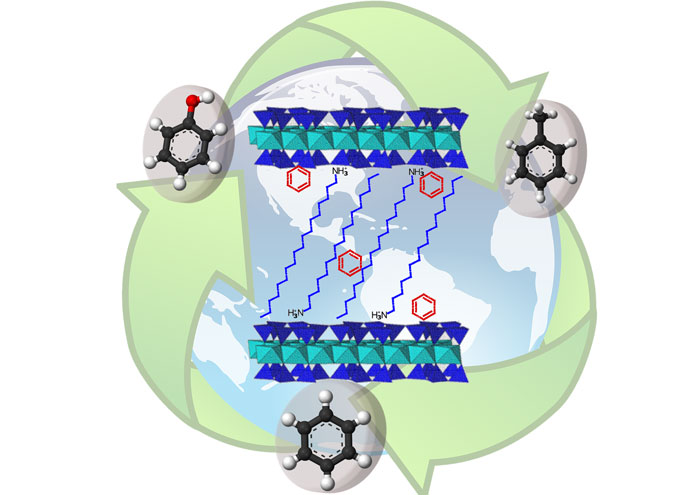
Researchers led by Dr. María D. Alba at the Materials Science Institute of Seville in Spain examined a novel family of synthetic swelling high-charged micas organo-functionalized with long chain alkylammonium cations. Their main objective was to analyze the sorption capacity of non-ionic hydrocarbons using the novel organomica family that allows a methodical analysis of the parameters that influence the procedure. In their work, the researchers used phenol, toluene and benzene as they are the major components of the wastewater from the petroleum refineries. The research work is now published in Journal of Industrial and Engineering Chemistry.
The authors observed that Cm-Mica-4 was effective absorbent in removing phenol from aqueous solutions and removal capability was noted to be a function of the chain length, the mass fraction and the organization of the organic cation in the structure of the layered silicate. The efficiency of the sorption of phenol on the C18-Mica-m was seen not to directly depends on the layer charged because it is a function of the initial concentration of phenol. The research team also noted that the C18-Mica-4 could effectively sorbed benzene, toluene and phenol, and, the nature of the organic solute and solvent interactions were the determinants of the degree of sorption of the organic pollutant.
María D. Alba and colleagues successfully presented a comprehensive study on the evaluation of novel synthetic high-charged organo-functionalized micas for the sorption of the non-ionic hydrocarbon pollutants: phenol, toluene and benzene. It has been seen that the sorption properties of non-ionic hydrocarbons by the high-charge organomicas can be controlled from the selection of the type of silicate precursor and the chain length of the organic cation. Therefore, these low cost organomicas of large surface area and easily available can be effectively used to treat petrochemical industries and oil refinery wastewater.






Acknowledgements
The authors would like to thank the Junta de Andalucía (Spain) and FEDER (Proyecto de Excelencia de la Junta de Andalucía, project P12-FQM-567), to the Spanish State Program R+D+I oriented societal challenges and FEDER (Project MAT2015-63929-R) for financial support. F.J. Osuna thanks his grant to the training researcher program associated to the excellence project of Junta de Andalucía (P12-FQM-567).
Reference
M. Carolina Pazos, Miguel A. Castro, Agustín Cota, Francisco J. Osuna, Esperanza Pavón, María D. Alba. New insights into surface-functionalized swelling high charged micas: Their adsorption performance for non-ionic organic pollutants. Journal of Industrial and Engineering Chemistry 52 (2017) 179–186.
Go To Journal of Industrial and Engineering Chemistry