Advances in Engineering Advances in Engineering features breaking research judged by Advances in Engineering advisory team to be of key importance in the Engineering field. Papers are selected from over 10,000 published each week from most peer reviewed journals.

Significance
In fluid mechanics, ship waves are the V-shaped pattern of waves in the wake of “vessels” in the widest sense, be it swimming ducks or supertankers. Ring waves are concentric waves formed on the surface of water, say by dropping a stone vertically into the water. The two forms of surface water waves have been admired since the dawn of time and studied scientifically for more than two centuries. Such attention can be attributed both to their beauty and intrinsic interest, and to the fact that they could be crucial to a wide range of problems in the naval, marine and ocean sciences. It has long been recognized that surface waves are profoundly affected by sub-surface shear, yet only recently has sub-surface shear been implemented in widely used ocean models and remote sensing of near-surface shear currents.
In particular, the modification of these surface waves by sub-surface shear flows has not been reported, despite the abundance of flows with strong vertical shear in nature; for instance, beneath the windswept ocean surface and in coastal and riverine waters. Bearing this in mind, a group of researchers recently published a study where they focused on investigating ring waves and ship waves skewed by shear in accordance with revelations of a recently published theoretical study. Simply put the researchers from the Department of Energy and Process Engineering, Norwegian University of Science and Technology, Norway: Benjamin Smeltzer, Eirik Aesoey and led by Professor Simen Ellingsen undertook laboratory experiments followed by quantitative comparisons with theoretical predictions for both ring waves and ship waves. Their work is currently published in Journal of Fluid Mechanics.
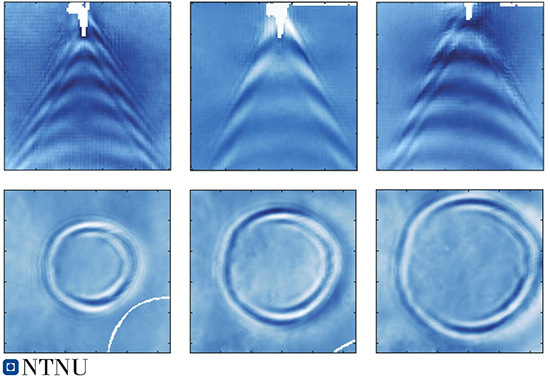
In brief, the research team reviewed the theory for calculating linear wave patterns on shear currents of arbitrary profiles, for comparison with their measurements. They described the experimental set-up, whereupon observations of ring waves and ship waves were presented and discussed. Ring waves and ship waves were created by blowing puffs of pressurized air onto the surface of a tailored shear current, and the surface elevation and shear profile measured using a synthetic schlieren method and particle image velocimetry, respectively.
The authors observed that in a region of strong shear beneath a stagnant surface, very visible shear effects were present. In fact, the effects were also clearly evident for a more-weakly sheared, approximately depth-linear current created by a curved mesh at the flow inlet. In addition, ring waves were reported to be clearly asymmetrical, while as ship waves appeared very different in shear-assisted, shear-inhibited and cross-current directions of motion.
In summary, the study reported on laboratory observations of ring waves and ship waves distorted by a sheared current beneath the surface. Remarkably, quantitative comparison of the dispersion curve for stationary ship waves in Fourier space revealed good correspondence considering the level of experimental accuracy. More so, the peak values of the measured two-dimensional Fourier spectrum for ship waves were shown to agree well with the predicted criterion of stationary ship waves, with the exception of some cases. In a statement to Advances in Engineering, Professor Simen Ellingsen was keen to point out that the results of their work could prioritize the development of efficient predictive tools for wave–body–shear current behavior in future studies.
“The results from their research on the Kelvin angle might have real practical consequences, such as potentially helping reduce fuel consumption in ships. A large portion of fuel on ships actually goes into making waves.” Said Professor Simen Ellingsen



Reference
Benjamin K. Smeltzer, Eirik Aesoey, Simen Ellingsen. Observation of surface wave patterns modified by sub-surface shear currents. Journal of Fluid Mechanics (2019), volume 873, page 508–530