Advances in Engineering Advances in Engineering features breaking research judged by Advances in Engineering advisory team to be of key importance in the Engineering field. Papers are selected from over 10,000 published each week from most peer reviewed journals.

Significance
A good number of processes today whether industrial, environmental or geochemical depends on the stability of colloidal clay minerals in one way or the other. As such, a new class of synthetic swelling micas has been synthesized to meet the high growing demands, especially in environmental protection through decontamination of hazardous cations owing to their superiority over natural clay minerals. This has also been escalated by the recent developed policies and regulation to mitigate pollution and global warming. Consequently, recent studies have shown that organoclays based hydrophobic materials exhibit excellent adsorbents properties especially for organic pollutants and thus can also be used for decontamination processes.
Alternatively, the capacity to use particular minerals for particular applications is determined by the surface properties of such minerals. Whereas some properties are easy to investigate and determine, others are quite complex and thus require sophisticated techniques. To this end, despite the remarkable applications of Na-Mica-n especially on the environmental decontamination and protection, little has been reported about their colloidal stability, which is a key consideration in enhancing their effectiveness.
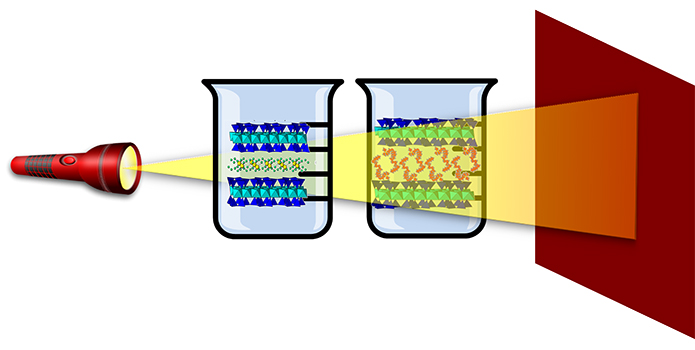
Recently, a group of researchers at the Material Science Institute of Seville (ICMS, CSIC-US) led by Dr. Maria Alba in Spain investigated the colloidal dispersion stability of the swelling high charged micas. They took into consideration the framework and interlayer space composition. Furthermore, they investigated the influence of the hydrophobic nature of the Na-Mica-n surface as well as the nature of the interlayer cations on their colloidal stability. Their research work is currently published in the research journal, Colloids and Surfaces A: Physicochemical and Engineering Aspects.
In brief, the research team explored the potential applications of the interlayer space of swelling 2:1 phyllosilicate and how they can be further advanced. Next, they synthesized the Na-Mica-n micas and then functionalized with ethylammonium. Also, their characteristics in terms of structural, morphological and compositional were examined together with their influence on the stability dispersion. Eventually, they determined the pH range upon which the Mica-n colloids became stable, taking into account their interlayer space composition and total layer charge.
The authors observed that the interlayer cation structural arrangement and the interlayer cation composition were the main factors that influenced the behavior of the colloidal dispersion stability. As such, they further noted that for the swelling high charged micas, their total charge contributed insignificantly to the colloidal dispersion stability.
In summary, the research team at Material Science Institute of Seville was the first to successfully prove the colloidal dispersion stability of swelling high charged micas. To actualize their study, they established a stable pH range for Na-Mica-n. Based on the experimental results, the study will altogether advance the design and synthesis of mica thus improving their effectiveness for the existing applications while at the same time paving way for developing new applications.






Reference
Osuna, F., Cota, A., Fernández, M., Pavón, E., Torres Sánchez, R., & Alba, M. (2019). Influence of framework and interlayer on the colloidal stability of design swelling high-charged micas. Colloids and Surfaces A: Physicochemical and Engineering Aspects, 561, 32-38.
Go To Colloids and Surfaces A: Physicochemical and Engineering Aspects