Advances in Engineering Advances in Engineering features breaking research judged by Advances in Engineering advisory team to be of key importance in the Engineering field. Papers are selected from over 10,000 published each week from most peer reviewed journals.

Significance
Optical chirality is the ability of a material or structure to distinguish between left- and right-circularly polarized light. This asymmetry is critical for many fundamental processes in biology, chemistry, and physics. For instance, in molecular biology, the specific interaction between chiral drugs and their biological targets can determine the difference between therapeutic success and toxic failure. In quantum optics, chirality governs spin-selective light-matter interactions that are critical for information encoding at the single-photon level. Despite this importance, creating nanostructures that exhibit precise, tunable, and reproducible chiral responses has proven to be a non-trivial challenge, often involving complex fabrication methods, a lack of general design rules, and an overreliance on inherently chiral geometries. The challenge is the absence of a unified design strategy and current metasurface technologies typically depend on either sculpting intrinsically chiral meta-atoms or assembling multi-layered, twisted architectures—approaches that may achieve strong chiral responses but suffer from practical limitations. These include high fabrication complexity, narrow spectral bandwidths, and a lack of scalability. Even when chirality is successfully introduced, controlling it with precision remains problematic. The design space is often too large, too sensitive to fabrication tolerances, or reliant on numerical optimization that offers little physical intuition. Moreover, many proposed structures are inherently rigid, offering limited dynamic tunability and little guidance on how to modulate chiral behavior post-fabrication.
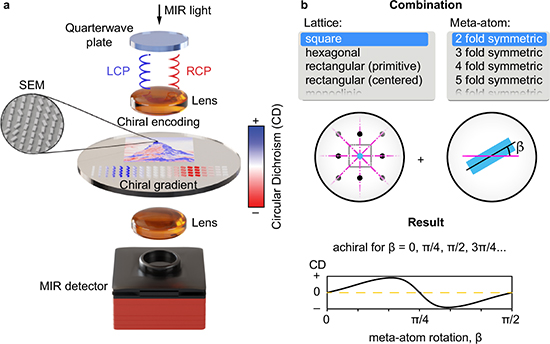
New research paper published in Nature Communications and conducted by Dr. Ivan Sinev, Felix Ulrich Richter, Ivan Toftul, Nikita Glebov, Kirill Koshelev, Yongsop Hwang, David G. Lancaster, and led by Professor Hatice Altug from the EPFL – Swiss Federal Technology Institute of Lausanne alongside Professor Yuri Kivshar from the Australian National University, the researchers developed a universal, symmetry-based design framework that enables precise control of optical chirality in metasurfaces by varying the rotation angle between resonators and their lattice arrangement. They fabricated gradient metasurfaces where this rotation parameter continuously changes across the chip, allowing predictable tuning and cancellation of circular dichroism at specific angles. This approach was further applied to encode dual-channel mid-infrared images in both transmission and chiral signals, demonstrating its robustness and practical potential for optical data storage and sensing.
The team designed a series of metasurfaces using germanium resonators placed on calcium fluoride substrates. They selected two resonator geometries—bar-shaped (C2v symmetry) and a tri-bar “spinner” (C3v symmetry)—and arranged them within square and hexagonal lattice configurations. Rather than fabricating separate samples for different angular orientations, they ingeniously implemented a continuous rotational gradient of the resonators across each chip. This allowed them to observe the evolving chiral behavior along a single sample strip, with the rotation angle β acting as the key control parameter. By using infrared spectroscopy with polarization resolution, they could directly measure the circular dichroism (CD) at each spatial location, effectively linking β to the chiral optical response in real time. The authors found in the metasurface where C2v bars were placed on a square lattice, the CD signal exhibited zeros exactly at β = 0°, 45°, and 90°, in perfect alignment with the predicted symmetry-protected “anchor” points. These nodes, where chirality was entirely suppressed, were robust across multiple resonant modes and spectral bands. The behavior repeated consistently in the other configurations, such as the C3v/square and C3v/hexagonal arrangements, where the angular intervals of chiral cancellation were determined by the least common multiples of symmetry orders. Even when extrinsic chirality was introduced unintentionally through the finite numerical aperture of the microscope—causing slight deviations at longer wavelengths—the main structure of the response held firm. Afterward, the team demonstrated a novel use case: dual-channel optical image encoding. By varying the resonator size and its rotation angle simultaneously, they were able to encode two distinct grayscale images into a single metasurface—one readable via total transmission, the other through CD. This feat was achieved without relying on complex phase modulation or multilayer stacking, but purely through symmetry tuning and geometric control. When illuminated in the mid-infrared, these metasurfaces revealed the embedded images with striking clarity, showing that optical information could be embedded directly into a chip’s physical architecture. What’s more, the encoding was resilient to local symmetry distortions caused by the gradient, underscoring the practical robustness of the method.
In conclusion, Professor Hatice Altug and Professor Yuri Kivshar with their research team advanced our understanding of chirality within metasurfaces and successfully introduced a generalized set of design rules anchored in fundamental group theory, the authors offer a path toward predictability in a field historically dominated by trial-and-error. This shift has immediate practical value. Instead of laboriously optimizing thousands of parameters in simulations, engineers can now tune a single variable—the rotation angle between meta-atom and lattice—and unlock or suppress chiral behavior with confidence. It’s not just elegant; it’s efficient. What this enables is a level of optical control that feels almost surgical. By knowing exactly when and where chirality will vanish or peak, devices can be designed with precise polarization-selective responses. That level of predictability is essential for sensitive applications like chiral molecule detection, where false positives can carry medical or pharmaceutical consequences. In quantum photonics, where spin-selective interactions underpin photon-based logic gates and entanglement, the ability to fine-tune chirality through structural design simplifies what would otherwise require complex active modulation. Perhaps most compelling is the potential for dual-channel optical encoding demonstrated in this work. Encoding information in both circular dichroism and total transmission—using the same physical platform—creates a new kind of optical data layer. This could find immediate use in security tags, covert image displays, and spectral barcoding. Unlike conventional holography, this approach is less vulnerable to alignment errors and far easier to fabricate at scale, since it doesn’t rely on phase modulation or depth control. It also lends itself to passive or low-power environments, which are critical for embedded sensing or on-chip diagnostics. Looking further ahead, the framework introduced here could serve as a foundation for dynamically reconfigurable optical systems. If the meta-atom rotation could be altered post-fabrication—via MEMS, strain, or electro-optic materials—the result would be metasurfaces capable of switching their chiral behavior in real time. This opens intriguing doors to adaptive optics, programmable polarization routers, or real-time biochemical sensors with tunable selectivity.

Reference
Ivan Sinev, Felix Ulrich Richter, Ivan Toftul, Nikita Glebov, Kirill Koshelev, Yongsop Hwang, David G. Lancaster, Yuri Kivshar, Hatice Altug. Chirality encoding in resonant metasurfaces governed by lattice symmetries. Nature Communications, 2025; 16 (1) DOI: 10.1038/s41467-025-61221-2