Advances in Engineering Advances in Engineering features breaking research judged by Advances in Engineering advisory team to be of key importance in the Engineering field. Papers are selected from over 10,000 published each week from most peer reviewed journals.

Significance
Ionic liquids exhibit high fluidities, high ionic densities and very low vapor pressures resulting from the combination of the anion and cation. They are molten organic salts having melting point lower than 100 °C. An ionic polymer consists of a polymer chain and charged ionic moiety in the repeating units such as poly(ionic liquid). They can be synthesized through quaternization of the existing polymers or by direct polymerization of the ionic liquid monomers.
Polyethers, on the other hand, are polar elastic materials with flexible and hydrophilic chains, and can be classified further as substituted and non-substituted polyethers. Their high solubility, excellent conductivity, and low toxicity make them desirable for extensive applications such as synthetic rubbers. Coordination anionic polymerization catalysts have been the widely used technique for preparation of polyethers. However, it results in poly (ECH) and ECH-copolymers with large molecular weight distribution (MWD) due to limited ability to control the polymerization as desired.
Several preparation techniques have been proposed to address the challenge. Unfortunately, the available methods for cationization of existing polyethers, especially those with high molecular weights, using a mixture of 1,4-diazabicyclo-[2.2.2]-octane and 1-azabicyclo-[2.2.2]-octane have not achieved their desired characterization fully.
A group of researchers at Zeon Corporation Research and Development Centre: Dr. Shigetaka Hayano, Mr. Keisuke Ota, and Dr. Hoang The Ban devised a new method for synthesis and fully characterization of cationic polyethers. The syntheses were based on imidazolium ionic liquid moieties in all the repeating units of polyethers. Their main aim was to achieve a narrow molecular weight distribution and also to characterize the properties and functions of the cationic polyethers. The work is currently published in the research journal, Polymer Chemistry.
The authors commenced their experimental work by first conducting the living anionic polymerization of epichlorohydrin to obtain poly(ECH). The produced poly(ECH) was then quaternized using 1-methylimidazole to get highly hydrophilic cationic polyether. Furthermore, high water retention and ionic conductivity were used to characterize the produced cationic polyether.
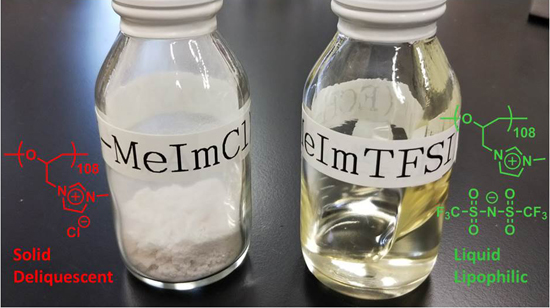
Zeon Corporation researchers successfully synthesized and characterized the properties and functions of the cationic polyethers. They observed that their various functions depended on the ionic moiety chosen while their properties depended on the cation and anion combination. For instance, this was the reason why the canonized polymers exhibited high miscibility with imidazolium-based ionic liquids. Also, poly(ECH-Melm+Cl–) had high deliquescence and excellent ionic conductivity which mainly depended on the water uptake.
The study by Dr. Shigetaka Hayano and colleagues is the first to study cationized poly(ECH) with polar methylimidazolium, and according to the authors, the resulting cationized polyethers are unique in terms of their functionality. Their functions are influenced by the combination of the main chain of the polyoxyethylene and ionic liquid moieties. Their miscibility with each other and in ionic liquids was relatively higher and thus could be used to prepare random copolymers through simple mixing. This was attributed to the fact that the cationic polyethers mixtures experienced no phase transitions between temperatures -70 °C to 100 °C. The technique is versatile and could also be used to develop a cross-linkage cationic polyether from unsaturated epoxide and cationization of ECH copolymer.


Reference
Hayano, S., Ota, K., & Hoang, B. T. (2018). Syntheses, characterizations and functions of cationic polyethers with imidazolium-based ionic liquid moieties. Polymer Chemistry, 9(8), 948-960.
Go To Polymer Chemistry