 Advances in Engineering Advances in Engineering features breaking research judged by Advances in Engineering advisory team to be of key importance in the Engineering field. Papers are selected from over 10,000 published each week from most peer reviewed journals.

Significance Statement
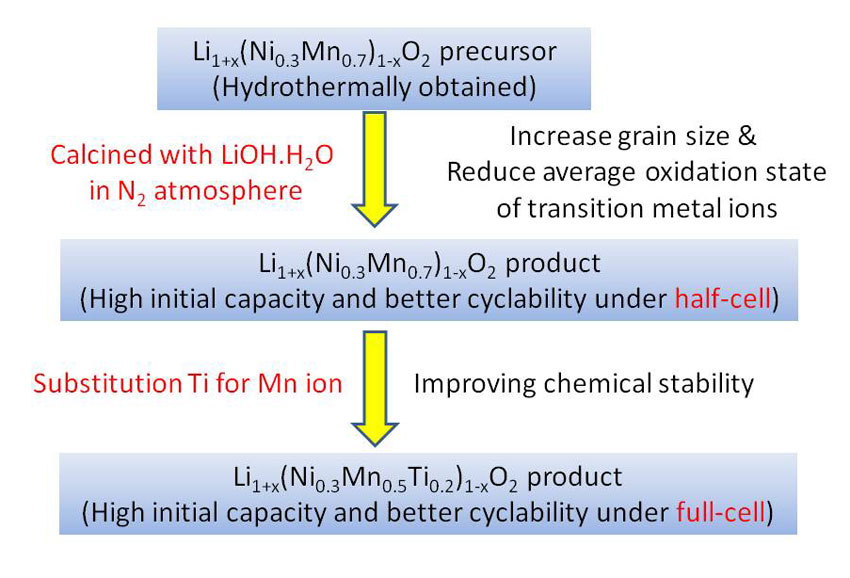
The Homogeneous Nickel (Ni) and Titanium (Ti) substituted Li2MnO3 solid solutions is synthesized by applying coprecipitation – hydrothermal – calcination method. This metal-oxide structure becomes stable with increases Ti contents during wide voltage range of electrochemical test (2.0-4.8V). Reduction in the average valence-state of Ni and Mn ions and Introduction of additional transition metal ion in Li layer is done by calcining in the Nitrogen atmosphere. Though incorporation of Ti ion decreases initial cycle efficiency, their cyclability is highly improved. This decrease in the efficiency is compensated by changing air to Nitrogen atmosphere in calcination process which also provide benefits like enhancing cyclability, initial capacity and suppressing voltage decay originated from progressive structural conversion. Hence a study was proposed by Dr. Mitsuharu Tabuchi from National Institute of Advanced Industrial Science and Technology (AIST) and colleagues at Sumitomo Chemical Co., Ltd. in Japan that inculcates calcination in Nitrogen atmosphere accompanied by Ti substitution and optimized composition to increase cyclability to thirty cycles under a full-cell configuration. In the study which was published in Electrochimica Acta a Li-rich positive electrode material, LiMO2– Li2MnO3 (M=Ni1/2Mn1/2) is used as a high-capacity one.
Better electrochemical cycle performance is achieved by implementing Ti substitution in the process. This Ti substitution also increases chemical stability even at higher upper voltage above 4.5V which in turn increases cycle performance. Further improvement in the electrochemical performance is achieved by calcining in an inert atmosphere. In the synthesis process, homogeneous Ni – Ti – Mn precursor is prepared by implementing coprecipitation under cooling and hydrothermal processes. The final product is obtained by calcination in air or nitrogen atmosphere and then repeated washing with distilled water followed by filtration and drying at 100 degree Celsius. Different samples are characterized by X-ray diffraction and Diffraction angle is also measured considering Si powder as an external standard for calibration. Various analysis are performed such as elemental analysis and analysis of average oxidation state of Ni and Mn by Inductively Coupled Plasma emission spectroscopy and iodometric titration respectively. In order to examine the cell properties, a coin-type lithium half-cell or full-cell (graphite negative electrode ) is used.
Analysis showed that the average oxidation state values of Ni and Mn in the samples calcined in Nitrogen atmosphere are lower than those that were calcined in air. It also indicated that the effect of Specific Surface area value on electrochemical properties is negligible. Hence there was drastic improvement of cyclability originated from the incorporation of stronger Ti-O bonds than Mn-O ones. During the process, stability was high even at higher upper voltage (4.8V) and the layer to spinel structural conversion was significantly suppressed like doping of K ion with Li in the Lithium layer. In addition, Rate performance was improved with the prevention of structural degradation effectively such as previously reported method like doping of Na ion with Li layer. These K and Na ions acted as “pillar” to suppress to serious structural deformation in the layered rock-salt structure. From the fact, the authors succeeded to make the transition-metal piller by controlling only calcination condition without doping neither K nor Na ion.
In the study, electrochemical property of Ni-substituted Li2MnO3 was found to improve if the Ti substitution is done for Mn. Although the results showed poor high-rate and low-temperature characteristics, better electrochemical performance and excellent cyclability were achieved by the process. Therefore, this study showed the Ni and Ti substituted Li2MnO3 have high-potential as high-capacity and “Co-free” positive electrode material, which is suitable for large-scale lithium-ion battery.

Journal Reference
Mitsuharu Tabuchi1, Hiroyuki Kageyama1, Kenji Takamori2, Yuichiro Imanari2, Kenji Nakane2, Synthesis and electrochemical characterization of Ni- and Ti-substituted Li2MnO3 positive electrode material using coprecipitation–hydrothermal–calcination method, Electrochemica Acta, Volume 210, 2016, Pages 105-110.
[expand title=”Show Affiliations”]- National Institute of Advanced Industrial Science and Technology (AIST), 1-8-31 Midorigaoka, Ikeda, Osaka 563-8577, Japan.
- Sumitomo Chemical Co. Ltd., 6 Kitahara, Tsukuba, Ibaraki 300-3294, Japan.
Go To Electrochimica Acta
