 Advances in Engineering Advances in Engineering features breaking research judged by Advances in Engineering advisory team to be of key importance in the Engineering field. Papers are selected from over 10,000 published each week from most peer reviewed journals.

Significance Statement
The synthesis of helical mesoporous silicas arises from the interest to acquire artificial helices that mimic natural systems with spiral structures, to favor the enantio-selective catalysis. To reinforce a unique orientationally sense, additional insertion of external chiral moieties inside helical channels constitutes a breakthrough for potential applications mainly as suitable catalysts for asymmetric synthesis.
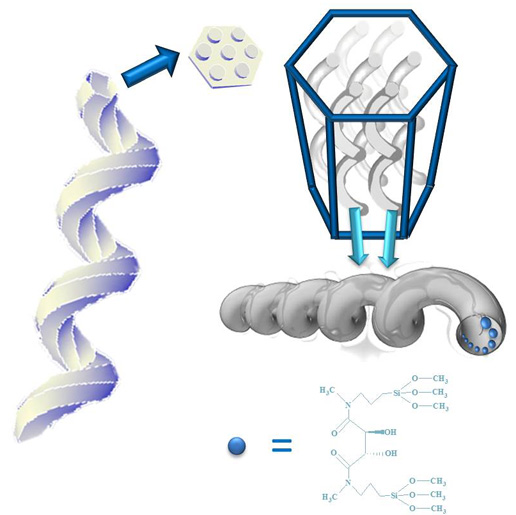
Exciting helical mesoporous organosilicas including supplementary chirally doped moieties into their spiral walls were one-pot successfully synthesized with good structural order for first time, to the best of our knowledge. The chirally doped materials exhibited helical structure and high BET surface area, pore size distributions and total pore volume in the range of mesopores. Solid-state 13C and 29Si MAS NMR experiments confirmed the presence of the chiral organic precursor in the silica wall covalently bonded to silicon atoms. Mannich diastereoselective asymmetric synthesis was chosen as catalytic test. The rigidity of the chiral ligand backbone provided by its integration into the inorganic helical wall, in combination with the steric impediments supplied by the twisted geometry led to the reagents to adopt specific orientations. These geometrical constrictions resulted in an outstanding diastereomeric ratio of 95:5 towards the preferred enantiomer. Therefore, these materials seem to induce an extra activity that could be highly beneficial not only in heterogeneous asymmetric synthesis but also in different applications, such as chiral separation, and even in drug delivery systems to maintain a sustained enantio-active pharmaceutical substance concentration in the bloodstream for an adequate application.
Langmuir, 2014, 30 (3), pp 881–890.
Rafael A. García-Muñoz *†, Victoria Morales †,María Linares ‡, Beatriz Rico-Oller †
†Department of Chemical and Environmental Technology and ‡Department of Chemical and Energy Technology, ESCET, Rey Juan Carlos University, C/Tulipán s/n, 28933, Móstoles, Madrid, Spain.
Abstract
Exciting helical mesoporous organosilicas including supplementary chirally doped moieties into their spiral walls were one-pot successfully synthesized with good structural order for, to the best of our knowledge, the first time. This one-step direct synthesis of helical chirally doped periodic mesoporous organosilica (PMO) materials was carried out by combination of a tartrate-based bis-organosilicon precursor with tetraethyl orthosilicate (TEOS) and two surfactants, cetyltrimethylammonium bromide and perfluoroctanoic acid (CTAB and PFOA). For comparison purposes, a conventional two-step postsynthetic grafting methodology was carried out. In this method, the chiral tartrate-based moieties were grafted onto the helical silica mesoporous materials previously prepared by the dual-templating approach (CTAB and PFOA). The chirally doped materials prepared by both methodologies exhibited helical structure and high BET surface area, pore size distributions, and total pore volume in the range of mesopores. Solid-state 13C and 29Si MAS NMR experiments confirmed the presence of the chiral organic precursor in the silica wall covalently bonded to silicon atoms. Nevertheless, one-pot direct synthesis led to a greater control of surface properties and presented larger incorporation of organic species compared with the two-step postsynthetic methodology. To further prove the potential feasibility of these materials in enantiomeric applications, Mannich diastereoselective asymmetric synthesis was chosen as catalytic test. In the case of the one-pot PMO material, the rigidity of the chiral ligand backbone provided by its integration into the inorganic helical wall in combination with the steric impediments supplied by the twisted geometry led to the reagents to adopt specific orientations. These geometrical constrictions resulted in an outstanding diastereomeric induction toward the preferred enantiomer.
Copyright © 2014 American Chemical Society
