Advances in Engineering Advances in Engineering features breaking research judged by Advances in Engineering advisory team to be of key importance in the Engineering field. Papers are selected from over 10,000 published each week from most peer reviewed journals.

Significance
The spectrum of the laser diode is an important characteristic that must be considered in the context of the laser diode pumping, because the spectrum of the laser diode depends on the temperature of the heat sink, therefore, only the length of the central wave of a laser diode is adjusted to compensate for temperature changes (such as changes in working current and the environmental temperature of the laser system), reaching a compromise between the absorption coefficient in the crystal and the efficiency energy, which could affect the uniformity of the pump and induce changes that cause the instability of the laser system.
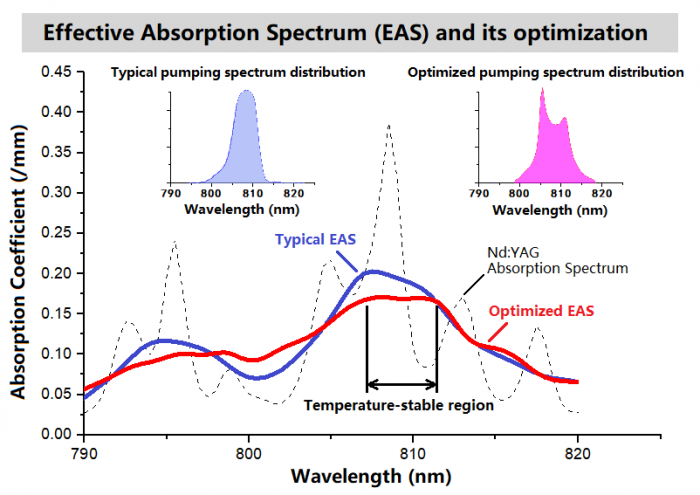
A group of researchers headed by Professor Tianzhuo Zhao at The Academy of Opto-electronics, Chinese Academy of Sciences demonstrated the application of an experimental configuration to achieve a stable wavelength control from the optimization of the spectral distribution of the laser diode, with the purpose of stabilizing the pumping uniformity when the temperature changes fluctuate in the center of the wavelength of the pump. Before carrying out this demonstration, the term effective absorption spectrum is disclosed, with the objective of correctly analyzing the spectral characteristics of the laser diode pump. The research work is now published in Journal, Optics Communications.
After obtaining the measurements of laser diode arrays emitting spectrum and absorption spectrum of the working material, , the calculation of the effective absorption coefficient was performed, assuming that the spectral distribution of the pump would be constant, when the length of the central wave of the laser diode matrices fluctuated from 780 at 830 nm, and the calculation of the effective absorption spectrum, which showed the influence of the temperature in the laser system pumped by laser diode.
On the other hand, the researchers determined that, when studying the effective absorption coefficient, the optimum laser diode spectrum profile, it is possible to obtain it in a single step, since each point in the laser diode’s spectrum contributes to effective absorption coefficient local, and the spectrum of the laser diode after the one-step optimization, generally changes the effective absorption spectrum. Likewise they revealed that, when the central wavelength of the laser diode changes, the effective absorption coefficient changes, causing fluctuations in the energy distribution of the pump in the rod, which causes the stability of the laser system to decrease.
By virtue of what has been explained, the research team proposed an amplification system to stabilize the distribution of the pumping energy in such a way that, the density of florescence in the center of the rod did not fluctuate when the ambient temperature changes in the region of the plateau of the effective absorption spectrum, the selecting a laser diode with appropriate central wavelengths or controlling the temperature of the cooling water of the amplifiers, while controlling the maximum intensity of the total spectral distribution of the pump by modulating the driving current of the assembly of the laser diode, and thus achieve a maximum power intensity ratio of 1.42. In addition to this, the internally developed amplifier allowed to develop a laser system capable of demonstrating the generation of 3.36 J laser pulses with a pulse width of 4.58 ns and a beam quality of 2.12 times the diffraction limit, at a frequency of 100 Hz .



Reference
Tianzhuo Zhao , Zhong wei Fan, Hong Xiao, Zhenao Bai , Wenqi Ge , Hongbo Zhang. Temperature-stable pumping realization through the optimization the pump-laser spectral distribution in optical amplifiers. Optics Communications Volume 402, 1 November 2017, Pages 551-556