Advances in Engineering Advances in Engineering features breaking research judged by Advances in Engineering advisory team to be of key importance in the Engineering field. Papers are selected from over 10,000 published each week from most peer reviewed journals.

Significance
Thermally responsive fibers are a type of smart fiber that can change their properties in response to changes in temperature. These fibers are made using materials that exhibit thermally induced changes in their physical or chemical properties. They are commonly used in a variety of applications, including textiles, biomedicine, and electronics. The most common type of thermally responsive fiber is made using shape memory polymers. These polymers have the ability to change their shape in response to temperature changes, which makes them useful for a wide range of applications. For example, in textiles, shape memory polymers can be used to create fabrics that change their shape or texture in response to changes in temperature. This can be useful for creating clothes that can adapt to different environmental conditions or for creating fabrics that can change their insulation properties. Another type of thermally responsive fiber is made using materials that exhibit thermochromism. Thermochromic materials change color in response to changes in temperature, which makes them useful for creating fabrics with color-changing properties. These fibers are commonly used in textiles and clothing to create products that can change color depending on the temperature or the wearer’s body heat. In electronics, thermally responsive fibers are used to create sensors and actuators. For example, they can be used to create temperature sensors that change their resistance in response to changes in temperature. They can also be used to create actuators that change their shape or properties in response to changes in temperature, which can be useful for creating micro-scale devices or for controlling the properties of larger devices.
One of their most notable applications is in the development of thermo-activated protective fabrics that are utilized in fields like aerospace, fire rescue wear, and physical protection. Fabrics that possess softness, flexibility and skin compatibility are considered favorable but their limitation is that they do not fare well in situations that involve change in mechanical conditions. Therefore, current fabrics cannot meet demand of unique applications such a personal protection, health monitoring and aerospace applications. Already available thermally responsive fabrics have either a very long response time or have poor comfort and wearability. With the need for exploring living space and increasing requirements for protective textiles, there is a growing demand for smart fabrics that possess good environmental adaptability. Developing such smart fabrics can enhance the functional and protective aspects of textiles, which can enable professionals to carry out specialized operations effectively.
In a new study published in Journal Advanced Functional Materials, State Key Laboratory for Modification of Chemical Fibers and Polymer Materials at Donghua University researchers, Dr. Chuanyue Sun, Dr. Jiabei Luo, Mr. Shengchang Yan, Prof. Kerui Li, Prof. Yaogang Li, Prof. Hongzhi Wang, Prof. Chengyi Hou and led by Professor Qinghong Zhang developed a new smart textiles that can adapt to the changes in environment is done (Research group links: https://pilab.dhu.edu.cn/afmg/). Currently most self-adaptive materials rely on altering the crosslink density of the polymer network or adjusting the conformation of the polymer chains between cross-linking points when triggered by external stimuli. However, since current methods can cause unwanted macroscopic volume changes in the polymer, a large-scale production cannot be carried out. Therefore, in the new study the authors focused on the development of self-adaptive smart fibers where production can be carried out continuously and that have a rapid response time.
The research team focused on solving the issue of poor interfacial bonding between commercial fibers and stimuli-responsive hydrogels. They were able to achieve this by using a new technique that involves solvent exchange and the creation of covalently anchored networks. Through this approach, they were successful in coating hydrogel skin evenly on a variety of commercial fibers and were able to manufacture thermally responsive fibers on a large scale. The resulting smart fibers were flexible, wearable, and gentle on the skin.
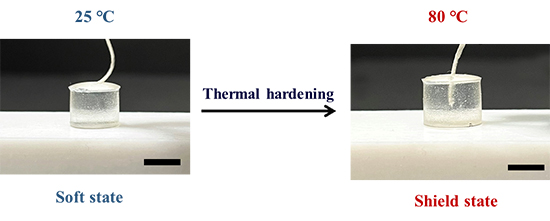
The authors prepared thermally responsive fibers by coating the hydrogel skin uniformly onto commercial fibers. To enable large-scale production, they created a device that automatically and continuously covers the commercial fibers with hydrogel skins. In order to enhance the bonding between the commercial fibers and the hydrogel, the fibers were first treated with a 0.8 m NaOH solution to expose the active groups on their surface, since the commercial fibers lacked functional groups for anchoring. When the temperature rises to 80 ℃, the hydrogel skin’s modulus increased significantly by 30883%, indicating excellent mechano-adaptability and impact resistance due to the synergy between hydrophobic interactions and ionic bonding (Figure 1). This synergistic effect also led to an increase in heat absorption, resulting in good thermal insulation properties of the fibers. As a result, the fibers were able to reduce the contact temperature of the body surface by approximately 25 °C when exposed to an external temperature of 95 °C, which effectively prevented thermal burns.
Professor Qinghong Zhang and co-workers successfully introduced a new approach for preparing thermally responsive smart fibers with a skin-core structure, where the hydrogel skin is firmly and uniformly coated on the surface of various commercial fibers through a specific covalent bond anchoring network. The immersion in salt solution increases the hydrogen bond density. The researchers developed a spinning device to enable the continuous large-scale production of the thermally responsive fibers, which can be applied to different commercial fibers. The hydrogel skin exhibits a transition from a rubbery to a glassy state at high temperatures through hydrophobic and ionic interactions, resulting in a temporary increase in modulus to enhance impact resistance (Figure 2). Furthermore, the phase transition caused by the temperature change absorbs heat, which reduces the temperature and protects the human body from scalding.
Thermally responsive fibers are crucial in creating versatile, thermoactivated protective fabrics. These types of fabrics can adjust to changes in temperature, providing thermal insulation when it is cold and releasing heat when it is hot. This makes them useful in various applications, including protective clothing for firefighters, military personnel, and astronauts, as well as for outdoor enthusiasts who require protection from extreme temperatures. By utilizing thermally responsive fibers in the production of these fabrics, they can provide enhanced comfort, flexibility, and protection for the wearer. In addition, thermally responsive fabrics can potentially reduce energy consumption by reducing the need for artificial heating and cooling, making them an eco-friendly solution. As technology continues to advance, it is likely that new and innovative uses for thermally responsive fibers will continue to be discovered.

Reference
Chuanyue Sun, Jiabei Luo, Shengchang Yan, Kerui Li, Yaogang Li, Hongzhi Wang, Chengyi Hou, Qinghong Zhang. Thermally Responsive Fibers for Versatile Thermoactivated Protective Fabrics. Advanced Functional Materials (2023) 33, 2211035