Advances in Engineering Advances in Engineering features breaking research judged by Advances in Engineering advisory team to be of key importance in the Engineering field. Papers are selected from over 10,000 published each week from most peer reviewed journals.

Significance
Porous metal-organic frameworks have recently attracted significant attention of researchers due to their applications in the areas of catalysis, sensing, gas storage among others. In particular, metal-organic framework-based materials with excellent properties and different functionalities can be realized through controllable synthesis and post-modification. For example, a composite functional metal-organic framework material has been developed by covalently compositing the nanosized particles with the organic polymers to enhance their compatibility.
This has led to the development of efficient nanosized metal-organic framework-based catalysts. However, the application of these catalysts is limited by the available separation procedures from the reaction systems just like the traditional separation methods. Therefore, development of reusable nanosized metal-organic framework-based catalytic material to fulfill the green and sustainability requirement is highly desirable.
Pickering emulsions have recently emerged as an excellent class of catalytic systems owing to their recyclability and high performance in response to the external stimuli. Alternatively, studies have shown that the metal-organic frameworks nanoparticles with functionalized polymer brushes exhibit the potential for use as Pickering emulsifiers due to their ability to enhance organic heterogeneous transformations. However, there is a great need to improve the biphasic catalytic efficiency as well as their cyclic utilization taking the stimuli-responsive metal-organic framework-based Pickering emulsifier into consideration.
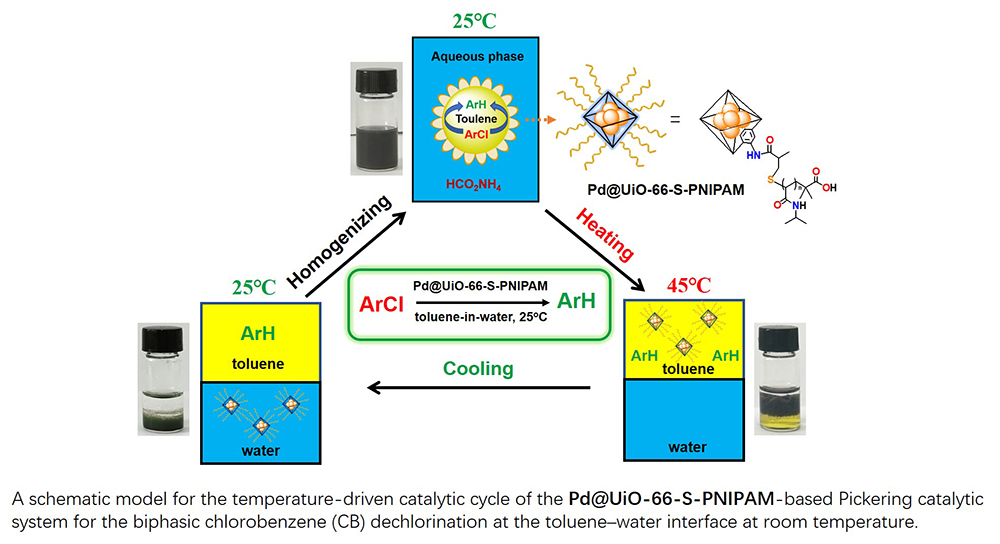
To this effect, researchers at Shandong Normal University: Dr. Bing-Jian Yao, Qi-Juan Fu, Ai-Xiang Li, Xiao-Man Zhang, Yan-An Li, and Professor Yu-Bin Dong developed a thermal-sensitive Pickering emulsion catalytic system based on the poly (N-isopropyl acrylamide) sulfide brushes-tethered UiO-66 type nanosized metal-organic frameworks. The process comprised of covalent composite approach and Pd nanoparticle loading step. Also, the performance of the obtained emulsifier was tested by evaluating the stabilization of toluene-in-water Pickering emulsion. Furthermore, the thermo-triggered emulsification and demulsification behaviors were investigated. The research work is currently published in the research journal, Green Chemistry.
From the experimental results, the authors observed that the obtained composite material was an efficient Pickering emulsifier. For instance, it enabled the stabilization of the toluene-in-water emulsion. This further enhanced the biphasic chlorobenzenes dechlorination at the toluene-water interface, especially at room temperatures. Also, the emulsifier triggered emulsification at room temperature i.e. 25°C and demulsification at a relatively high temperature of 45°C of the toluene droplets. This was attributed to the thermo-responsive nature of the emulsifier. Furthermore, it was worth noting that the Pickering emulsion catalytic system is renewable and can be reused more than five times without losing its catalytic activities.
In summary, the Shandong Normal University scientists led by Professor Yu-Bin Dong are the first to report UiO-66-S-PNIPAM Pickering emulsifier and explore its potential use in the enhancing the stability of the toluene-in-water Pickering emulsion and the benefits of its emulsification and demulsification behaviors. Interestingly, the emulsifier can be recycled and reused without losing its catalytic activities thus a great step in enhancing green chemistry. Altogether, the study provides essential information that will enable the construction of advanced metal-organic framework-based Pickering emulsion catalytic systems capable of addressing various environmental-related problems such as global warming.


Reference
Yao, B., Fu, Q., Li, A., Zhang, X., Li, Y., & Dong, Y. (2019). A thermo-responsive polymer-tethered and Pd NP loaded UiO-66 NMOF for biphasic CB dechlorination. Green Chemistry, 21(7), 1625-1634.
Go To Green Chemistry