 Advances in Engineering Advances in Engineering features breaking research judged by Advances in Engineering advisory team to be of key importance in the Engineering field. Papers are selected from over 10,000 published each week from most peer reviewed journals.

Significance
Recently, studies involving laser marking processes have attracted significant attention of researchers. This can be attributed to the rapid growth in laser marking applications also in areas with sensitivity to material properties changes during marking. But still, no effective technology has been developed for accurate surface temperature measurements during laser marking. This is necessary to understand the fundamentals regarding the material properties changes during laser irradiation.
Generally, some of the characteristics considered in various temperature measurements methods include the measurement principle, the temperature range, response time and the type of detector used. Alternatively, recent studies have shown that time-resolved reflectivity measurement is widely preferred over its counterparts like the pyrometers. Also, laser marking of stainless steels have experienced challenges associated with the type of laser used, process parameters involved and the material properties which, for example, can affect the corrosion resistance of the material either negatively or positively. As such, understanding the relationship between the aforementioned parameters and the corrosion resistance of the material is highly desirable. Unfortunately, this has proved difficult to realize due to lack or time-resolved temperature measurement methods.
To this note, researchers at the University of West Bohemia: Dr. Martin Kučera, Dr. Jiří Martan and Dr. Aleš Franc from the New Technologies Research Centre in the Czech Republic developed a novel time-resolved surface temperature measurement system for laser marking processes. In particular, the system was resolved in the nanosecond time scale and its feasibility was verified by application in the laser marking of stainless steels. Consequently, the authors investigated the relationship between the surface temperature, laser marking parameters, microstructure and resulting materials properties such as corrosion resistance. Their research work is currently published in the research journal, International Journal of Heat and Mass Transfer.
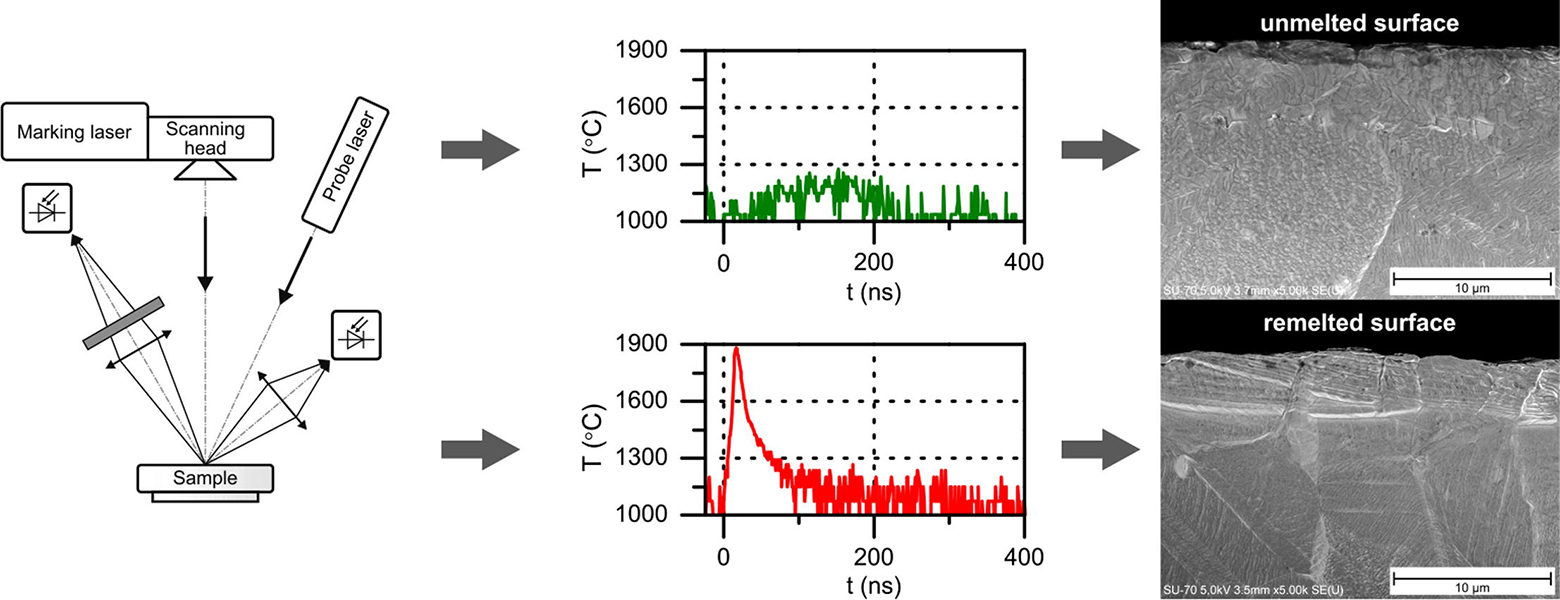
Briefly, the authors commenced their experimental work by marking the stainless steels using a variable nanosecond pulsed fiber laser. Then, the calibration of the measurement system was based on solidification phase change. Next, thermal processes involved during laser marking process were examined. Finally, the factors affecting the maximum surface pulse temperatures were determined.
It was necessary to examine the markings obtained by different laser parameters. The authors observed that visually similar markings resulted in different corrosion resistance and phase composition, which was in good agreement with the maximum temperatures obtained. Also, it was noted that higher pulse temperatures induced surface melting up to a thickness of 4 µm. However, poor corrosion resistance was due to surface melting at temperature up to 1870 °C while no melting was observed for good corrosion resistance at temperatures lower than 1100 °C. Furthermore, the key factors affecting the maximum pulse temperature were noted to be pulse duration and the previously induced pulses due to accumulated heat effects.
In summary, University of West Bohemia scientists successfully demonstrated the effectiveness of the time-resolved surface temperatures measurements. In general, the study provided vital information regarding the correlation between the physical processes, microstructures and the material properties such as corrosion resistance. Therefore, it will advance not only laser marking of stainless steels but also other laser processes and materials.

Reference
Kučera, M., Martan, J., & Franc, A. (2018). Time-resolved temperature measurement during laser marking of stainless steel. International Journal of Heat and Mass Transfer, 125, 1061-1068.
Go To International Journal of Heat and Mass Transfer