Advances in Engineering Advances in Engineering features breaking research judged by Advances in Engineering advisory team to be of key importance in the Engineering field. Papers are selected from over 10,000 published each week from most peer reviewed journals.

Significance
The popularity and increased applications of high liquid repellant surfaces can be attributed to their unique antibacterial, antifouling, anticorrosion and anti-icing properties as well their environmental benefits and energy savings due to reduced friction and residues. However, large-scale production of such surfaces for various applications has remained a significant challenge due to a lack of simple, cost-effective and scalable production methods. Moreover, the existing production strategies are either based on non-scalable techniques or involve several fabrications steps that further complicate producing hydrophobic surfaces. Therefore, large-scale production of special surfaces is critical in expanding their applications, and it demands the development of more effective production methods.
Textured and slippery lubricated surfaces are the two main surfaces with special wettability properties. Interestingly, they are both inspired by nature and require either hydrophobic and textured substrates. The textured surfaces can be realized by either generating porosity or roughness on low-surface energy substrates or chemically modifying the textured structures with low-surface-energy compounds. However, these approaches require additional fabrication steps making the production methods more cumbersome and complicated. Lately, research has concentrated on scaling and simplifying the existing methods while enhancing the properties of the resulting surfaces. For example, previous research on materials with excellent liquid repellency concentrated on generating liquid/lubricant infused surfaces (LIS) using superhydrophobic textured polymer layers. To produce durable and stable LIS, many surface properties such as roughness, porosity and re-entrant must be considered.
Motivated by the previous research findings, a group of researchers from the Spanish National Research Council: Elisabet Afonso, Dr. Aránzazu Martínez-Gómez, Dr. Pilar Tiemblo, Dr. Nuria García proposed a simple and scalable industrial method for production of all-polymer hydrophobic surfaces for slippery LIS. The surfaces were built on PVDF/PMMA blended films. The decision to use PVDF was partly based on its remarkable mechanical and chemical properties, its complex crystalline morphology, and its capability to form homogenous blends with different polymers. In particular, the authors explored the morphological and miscibility tuning of PVDF/PMMA blends to construct superhydrophobic surfaces, which is sparsely studied in the literature. Furthermore, the feasibility and practicability of the proposed methods were validated by demonstrating the effectiveness of the resulting surfaces in generating LIS layers with outstanding slippery properties. Their research work is currently published in the research journal, Applied Surface Science.
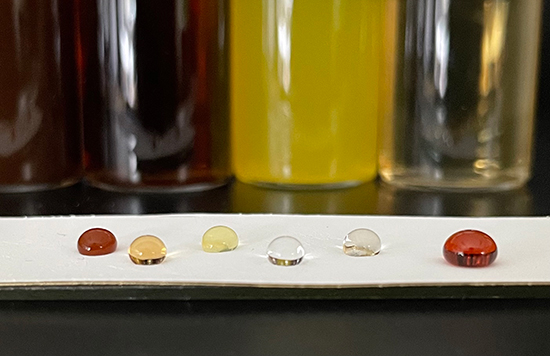
Results demonstrated that the methodology is simple and easy to implement as it does not require fluorination like most of the existing methods. This enabled fast and easy preparation of the rough surfaces via treatment with common solvents like ethanol, and the roughness profile could be tuned by varying the solvent immersion time. Based on the analysis of the roughness parameters, the hydrophobicity of the surface increased with more re-entrant profile. Furthermore, the surfaces were successfully infused with lubricants, specifically silicon oils, to prepare LIS. The resulting surfaces were not only homogenous and transparent but also exhibited relatively high water sliding velocities.
In summary, the study demonstrated the effective preparation of large surfaces exhibiting superhydrophobic properties desirable to generate liquid-infused surfaces with outstanding slippery properties. This method relied on the advantage of the multiphasic nature of the two conventional polymers and their associated blends as well its ability to effectively control the kinetics of the resulting morphology, which is considered a critical feature of polymers. Based on the results, the re-entrant profile was identified as a key parameter in LIS design. In a statement to Advances in Engineering, the authors noted that the scalability, simplicity, and efficiency of the proposed method makes it promising for fabricating high-performance surfaces for numerous applications. In addition, they pointed out that this work is a proof of concept of this methodology, which is being testing with other conventional polymers.

Reference
Afonso, E., Martínez-Gómez, A., Tiemblo, P., & García, N. (2021). Industrially viable method for producing all-polymer hydrophobic surfaces apt for slippery liquid-infused substrates. Applied Surface Science, 535, 147728.