 Advances in Engineering Advances in Engineering features breaking research judged by Advances in Engineering advisory team to be of key importance in the Engineering field. Papers are selected from over 10,000 published each week from most peer reviewed journals.

Significance
Heat conduction lasting for only a short time is quite common in thin layers embedded between two semi-infinite media. Basically, the temperature in such conditions has singularities at zero time and depths when initial temperatures differ. Consequently, these singularities have been seen to hamper accurate numerical solution and worse off, complicate analytical solutions. For a purely resistive layer between semi-infinite media, general solutions for the case of composite slabs or multilayers have been derived by separation of variables, using Laplace transform, Sturm–Liouville integral transform and by natural Eigen function expansion. However, they still tend to be complex and often require the evaluation of integrals, eigenvalues, or infinite series with an uncertain truncation error.
Recently, Leendert van der Tempel (currently at Signify Research), Willem Potze and Jeroen Lammers at Philips Research in the Netherlands developed a novel series expansion and a new approximation with accurate singularity treatment for the temperature in the case of transient heat conduction in a single thin layer with a surface heat flux between two semi-infinite media at different uniform initial temperatures. Their work is currently published in Journal of Heat Transfer.
The research method employed entailed the derivation of the approximation and expansion series for the temperature for the stated cases. Next, Laplace transformation of the model was used to simplify the partial differential equations to ordinary differential equations. Lastly, the temperature accuracy of the derived series was evaluated for two test cases in the field of thermoplastic shaping of polymers.
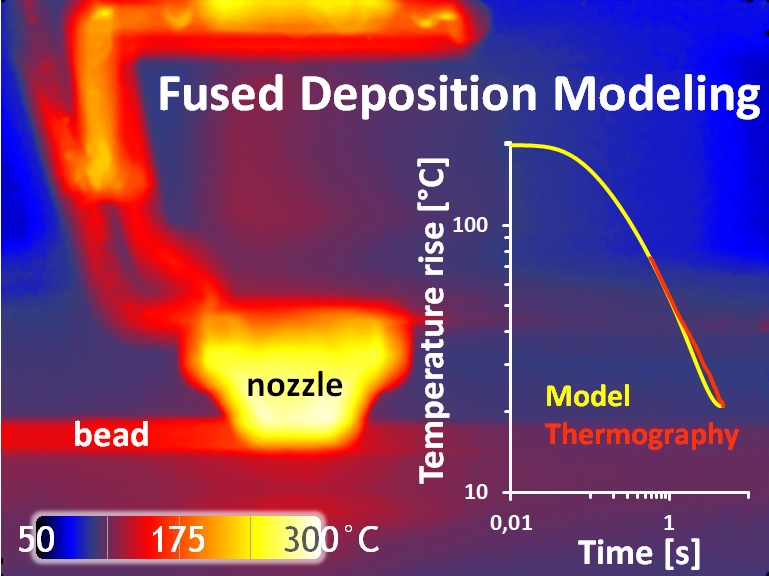
The authors observed that the series converged rapidly in the injection molding and fused deposition modeling test cases below 1 μK truncation error within two terms fitting in one spreadsheet cell and involving only 8–12 function evaluations. In addition, the researchers noted that the relative accuracy at the singularity in the origin was excellent. Moreover, they found out that the approximation fitted in one spreadsheet cell and involved 14 function evaluations. For the injection molding test case, it was seen to have 56 K and in the fused deposition modeling test case 3.5 mK approximation error. The asymptotic behavior of the relative accuracy for short and long times was also seen to be correct.
In a nutshell, Leendert van der Tempel and colleagues successfully presented the derivation of a series expansion and an approximation for temperature in the case of transient heat conduction in a thin layer between two semi-infinite media at different uniform initial temperatures. The series expansion and the approximation were evaluated as 3 orders of magnitude more accurate in the fused deposition modeling test case than the previously published convective approximation. Altogether, the developed series expansion enables quick yet accurate thermal analysis of compression molding, injection molding, and fused deposition modeling and in particular the depth distribution of the vitrification rate. The logarithmically weighted depth average of the vitrification rate explains the measured post-molding volume shrinkage.

Reference
Leendert van der Tempel, Willem Potze, Jeroen H. Lammers (2018). Transient Heat Conduction in a Thin Layer Between Semi-Infinite Media in Polymer Shaping. Journal of Heat Transfer, volume 140 page 041301-8.
Go To Journal of Heat Transfer