Advances in Engineering Advances in Engineering features breaking research judged by Advances in Engineering advisory team to be of key importance in the Engineering field. Papers are selected from over 10,000 published each week from most peer reviewed journals.

Significance
Heat escapes through conventional window glazing whenever temperature gradients drive molecular energy transfer across air gaps and solid panes, a process that persists even when modern architectural designs attempt to minimize conductive pathways. That simple physical reality explains why windows account for a disproportionately large fraction of energy loss from buildings despite occupying a comparatively small fraction of exterior surface area. Thermal leakage through glazing systems continues to impose large energy demands on heating and cooling infrastructure, and it remains one of the least tractable elements of building-scale energy management. Transparent thermal barriers have long been proposed as a remedy. Aerogels, porous silicas, and related lightweight solids offer low thermal conductivity because their pores disrupt heat transport through gases and solids. Yet optical clarity introduces a different constraint. Light scattering intensifies when pore sizes vary across micrometer scales or when internal refractive-index contrasts become large. Many aerogels possess exactly these characteristics: disordered networks of particles or fibers whose pore distributions extend across several orders of magnitude. That structural heterogeneity creates the familiar hazy appearance associated with highly porous solids. When thickness increases beyond a few millimeters, scattering accumulates to the point that visibility degrades sharply.
Attempts to refine pore uniformity in silica or cellulose aerogels have produced partial improvements. Nanocellulose structures and carefully templated silica networks can suppress scattering in thin films, although thickness scaling remains problematic. Optical clarity requires pore dimensions substantially smaller than the wavelength of visible light. Thermal insulation requires pore sizes smaller than the mean free path of air molecules so that molecular collisions with pore walls interrupt heat transfer. Achieving both simultaneously imposes a narrow geometric window: pores must remain on the order of tens of nanometers while maintaining spatial uniformity across macroscopic volumes.
Mesoporous materials provide an appealing starting point because surfactant assemblies can template nanoscale structures with unusually precise dimensional control. Surfactant micelles often form cylindrical or lamellar phases capable of guiding inorganic frameworks during gel formation. Researchers have exploited such templating strategies for catalysis and adsorption technologies, though these materials rarely extend beyond laboratory-scale synthesis. Translating mesoporous architectures to meter-scale building components introduces an additional complication: the nanoscale order must persist across large volumes without collapsing during drying or solvent removal.
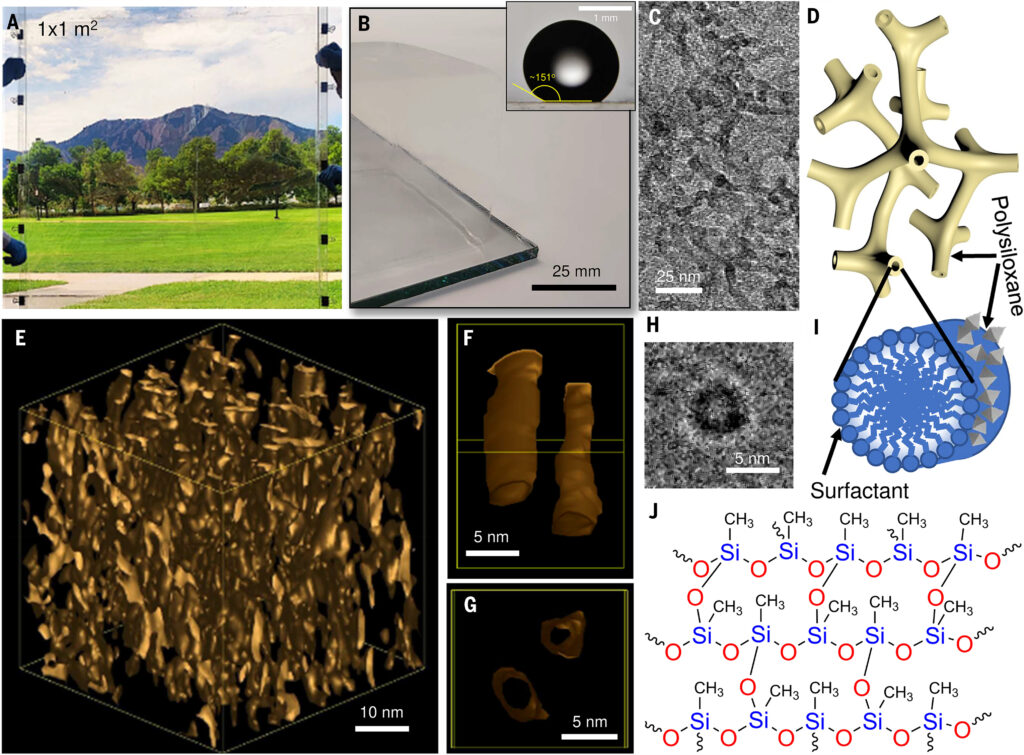
Those limitations motivate the exploration of kinetically directed self-assembly processes capable of generating three-dimensional pore networks while maintaining structural control below roughly fifty nanometers. If the internal geometry of such networks could be maintained during large-scale fabrication, a material might simultaneously block heat conduction through confined gases and transmit visible light with minimal scattering. The conceptual challenge does not stem from a single property but from the delicate coordination of structural length scales, fabrication chemistry, and mechanical stability. Small variations in pore size, orientation, or solid fraction alter optical transmission, refractive index, and thermal transport in ways that can rapidly degrade performance. A recent research paper published in Science Journal and conducted by Dr. Amit Bhardwaj, Dr. Blaise Fleury, Dr. Bohdan Senyuk,Dr. Eldho Abraham, Dr. Jan Bart ten Hove, Dr. Taewoo Lee, Dr. Vladyslav Cherpak, and led by Professor Ivan Smalyukh from the University of Colorado Boulder, the authors developed mesoporous polysiloxane metamaterials composed of interconnected nanotube networks templated by surfactant micelles. Their fabrication strategy produced centimeter-thick slabs and meter-scale films with pore dimensions below roughly thirty nanometers. This architecture combined visible-range transparency exceeding ninety-nine percent with thermal conductivity well below that of air. The approach differs from conventional aerogel systems because uniform tubular networks replace polydisperse particle aggregates, allowing optical clarity and thermal insulation to coexist within a single material structure.
Briefly, the investigators prepared aqueous solutions containing cetylpyridinium chloride surfactant and introduced methyl trimethoxy silane as a precursor for the inorganic framework. Acid-driven hydrolysis initiated silane condensation, while tetramethyl ethylene diamine promoted cross-linking of the developing polysiloxane network. During this stage, cylindrical micelles organized into extended graph-like structures that guided the growth of thin polysiloxane walls around them. The researchers transferred the reacting mixture into molds of controlled geometry and allowed gelation to proceed at moderate temperature for periods that depended on sample thickness. That step generated polysiloxane hydrogels whose internal geometry mirrored the surfactant network. After gel formation, the team replaced water with ethanol through repeated washing cycles, which removed surfactant molecules and preserved the tubular pore structure. They then carried out supercritical drying using carbon dioxide to eliminate capillary forces that would otherwise collapse the nanoscale architecture. Electron microscopy revealed networks composed of hollow polysiloxane tubes interconnected in three-dimensional graphs. The authors measured internal tube diameters close to the dimensions expected from the surfactant templates, while the spaces between neighboring tubes typically remained near thirty nanometers. Such dimensions fall well below both the wavelength of visible light and the mean free path of air molecules at ambient pressure. This geometric constraint plays a decisive role in the material’s physical behavior because confined air molecules collide with pore walls more frequently than with one another, which suppresses gas-phase heat conduction. They showed using optical measurements that the investigators achieved exceptionally high transparency across the visible spectrum. Light transmission exceeded ninety-nine percent for normally incident radiation, and the material maintained strong transparency even when light entered at steep angles. The small refractive-index difference between the porous network and surrounding air reduced reflection at interfaces, which further contributed to the near-invisible appearance of thick slabs. Plus thermal characterization revealed conductivities near ten to twelve milliwatts per kelvin per meter, substantially lower than that of still air. The research team attributed this outcome to two cooperating effects. Nanoconfined air restricted gas conduction, while the sparse polysiloxane framework offered limited solid-state heat pathways because its geometry interrupted phonon transport at numerous junctions. Radiative heat transfer also diminished because the polysiloxane network absorbed strongly in thermal infrared wavelengths.
The authors fabricated films approaching square-meter scale and slabs exceeding several centimeters in thickness without losing structural coherence. They also demonstrated that adjacent pieces could form optical contact when pressed together, which allowed larger insulating panels to emerge from multiple sections. That approach implicitly acknowledges a manufacturing trade-off: supercritical drying vessels impose size constraints, so modular assembly offers a practical path toward architectural dimensions.
To summarize, Professor Ivan Smalyukh and colleagues demonstrated that the new material architecture explored in their work carries implications extending beyond a single fabrication strategy. Transparent insulation has long appeared as a desirable concept in energy-efficient construction, yet most candidate materials compromise either optical clarity or thermal resistance. The nanoscale organization of the polysiloxane networks offers a way to circumvent that long-standing compromise because it addresses both scattering physics and heat transport through the same geometric constraint: uniform pores below several tens of nanometers. Building envelopes provide an immediate technological setting for such materials. Windows transmit daylight while allowing substantial heat exchange with the outdoor environment. Conventional double-pane glazing reduces conduction by trapping air layers, though its insulating capacity remains modest relative to opaque walls. Incorporating mesoporous insulating slabs inside glazing units introduces an alternative mechanism. Air confined within nanoscale pores cannot circulate or conduct heat efficiently, which sharply reduces thermal transport while maintaining optical transmission. Plus, e experimental window assemblies built around these materials demonstrate thermal resistance values comparable with those of wall structures of similar thickness. Such performance carries architectural consequences. If transparent elements no longer impose severe energy penalties, building designs could incorporate larger glazed areas without escalating heating or cooling loads. Daylighting strategies might shift accordingly, with window placement determined more by visual and spatial considerations than by thermal compromise. The optical characteristics of the material also influence how light interacts with building interiors. The refractive index remains close to that of air, which suppresses reflection at interfaces and preserves natural color perception. Unlike conventional insulating materials that scatter light diffusely, the mesoporous network allows direct transmission with minimal haze. This property may prove valuable in retrofitting existing windows because occupants typically resist solutions that alter visual clarity. Energy applications extend beyond passive insulation. The researchers demonstrated that the material transmits solar radiation while absorbing thermal infrared wavelengths emitted by heated surfaces. Enclosing a solar absorber with such a transparent barrier traps heat inside the system while allowing incoming sunlight to reach the absorber. Under unconcentrated sunlight, the setup achieved stagnation temperatures approaching three hundred degrees Celsius, which surpass many previously reported passive solar thermal configurations. That capability suggests potential integration into building envelopes where sunlight drives localized heating processes. Durability also enters the discussion. Polysiloxane frameworks resist moisture and thermal degradation, and accelerated aging experiments reveal stability over multi-year time scales. Even with such encouraging signs, practical deployment depends on manufacturing cost, scalability of drying processes, and compatibility with established glazing technologies. Modular assembly through optical contact may mitigate some of these concerns, although industrial translation will require further refinement of fabrication logistics.

Reference
Bhardwaj A, Fleury B, Senyuk B, Abraham E, Ten Hove JB, Lee T, Cherpak V, Smalyukh II. Mesoporous optically clear heat insulators for sustainable building envelopes. Science. 2025 Dec 11;390(6778):1171-1176. doi: 10.1126/science.adx5568.