Advances in Engineering Advances in Engineering features breaking research judged by Advances in Engineering advisory team to be of key importance in the Engineering field. Papers are selected from over 10,000 published each week from most peer reviewed journals.

Significance
Recently, phones comprising of a screen that folds have been introduced. Foldable smartphones have been a long time coming, and they are not just gimmicks. They are glimpses of the next great mobile frontier. Current trends where people want larger screen sizes yet portable and pocketable devices has been the motivation towards such developments. Technically, materials that are both wear-resistant and bendable are rare because hard inorganic materials are normally brittle and flexible polymer materials typically lack wear resistance. Transparency for such a material would be a plus as it could help fulfil many applications; such as touchscreens for foldable phones. Naturally occurring hard and tough (not brittle) materials are mostly made of inorganic/organic nanocomposites. They possess Young’s moduli close to those of the inorganic components because the inorganic nanophases bear most of the tensile loads. The first synthetic inorganic/organic molecular composite that meets a suitable criterion similar to that of the desired material has been recently reported. The reported composite is transparent and flexible and possesses a pencil hardness exceeding 9H; whose precursor was siloxane consisting of a ladder-like silica core and 3,4-epoxycyclohexyl ethyl groups that were attached to the Si atoms.
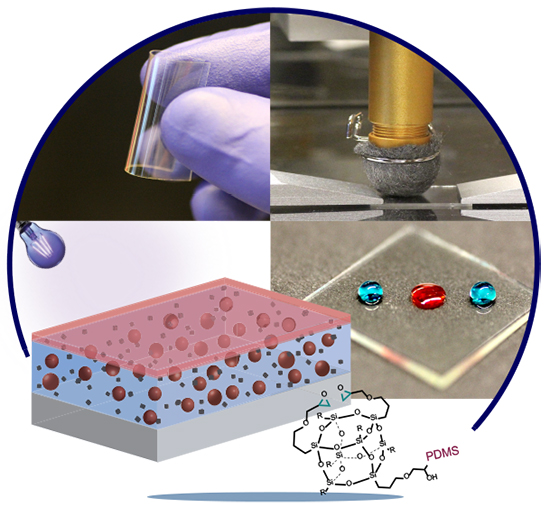
A thorough review of existing literature reveals that transparent omniphobic or anti-smudge coatings with glass-like wear resistance and polymer-like bendability have many potential applications; unfortunately, but there are no reports of such materials. On this account, Canadian researchers from the Department of Chemistry at Queen’s University: Kaka Zhang, Shuaishuai Huang, Jiandong Wang and led by Professor Guojun Liu developed a transparent polymer/inorganic hybrid coating that had a pencil hardness exceeding 9H and was simultaneously so flexible that a rectangularly-shaped sample of the resulting composite on a poly (ethylene terphthalate) (PET) substrate could be rolled into a tube. Their work is currently published in Angewandte Chemie International Edition.
In their work, the research team prepared the composite via the photo-initiated ring-opening polymerization of the epoxide rings of glycidyloxypropyl polyhedral silsesquioxane (GPOSS). The team chose GPOSS because it was structurally similar to the ladder-like siloxane. While the desired hardness was provided by the silica core, the flexibility was imparted by the glycidyloxypropyl network.
The authors reported that oil and water repellency was achieved without adversely affecting the other properties by incorporating a low-surface-tension liquid lubricant poly (dimethyl siloxane). Furthermore, the researchers pointed out that on the final coating, various organic solvents and water readily and cleanly glided, while complex fluids, such as ink and paint facilely contracted.
In summary, the study by Queen’s University scientists demonstrated a high flexibility and wear resistance of a coating that was prepared from a commercial precursor GPOSS. Remarkably, their study showed that the coating could be photocured in one step within 5 minutes. In a statement to Advances in Engineering, Professor Guojun Liu, the lead author and Canada Research Chair in Materials Science mentioned that while their design principle they presented may be extended for the development of coatings from other types of organic/inorganic nanoclusters, the current coating may already have practical applications.

Reference
Kaka Zhang, Shuaishuai Huang, Jiandong Wang, Guojun Liu. Transparent Omniphobic Coating with Glass-Like Wear Resistance and Polymer-Like Bendability. Angewandte Chemie International Edition 2019, volume 58, page 12004 –12009.