 Advances in Engineering Advances in Engineering features breaking research judged by Advances in Engineering advisory team to be of key importance in the Engineering field. Papers are selected from over 10,000 published each week from most peer reviewed journals.

Significance
Fabrication and manipulation of various materials at both microscale and nanoscale levels have given birth to several advanced new technologies as compared to the traditional ones. For instance, recent advancement in the field of imaging systems is attributed to the development of efficient white-light interferometers. This has further attracted significant attention of scientists owing to its excellent properties such as a true color display. Consequently, white-light interferometry has been used in sample testing of surface conditions. Presently, among the available types of white-light interferometry, scanning white-light interferometry is widely used in surface characterization. Unfortunately, the techniques generally based on the piezoelectric transducer that requires a significant amount of time to set up and operate.
To this note, Nanjing University of Science and Technology researchers led by Professor Tao ChunKanand from the Department of Optics in China identified a static state-based imaging method as a promising solution for characterization of finer surface details. Fundamentally, they developed an efficient and true color imaging method that is less time-consuming. Their research work is published in the research journal, Optics Communications.
In brief, the developed technique was based on the sub-dark field illumination in the white-light interferometry. Also, the imaging method was presented in the principal interference fringe produced by the white light interference. Next, the surface profiles of the test samples for both smooth and rough surfaces were analyzed using the newly developed method to validate its effectiveness. Furthermore, the relationship between the optical path difference and the desired colors were determined using the true color sequence band. Lastly, the properties and characteristics associated with the white-light interference images were analyzed.
Based on the experimental results, the research team observed that the developed method was much fast as compared to the traditional convention ones. Consequently, both the smooth and rough surface profiles were efficiently resolved. On the other hand, the relationship between the optical path difference and the surface colors were successfully analyzed. Also, a maximum value for the image contrast was obtained in principal interference fringe which was attributed to coinciding between the tested surface and the interference reference surface. Furthermore, sub-dark field illumination was noted to depend mainly on the equal thickness of the interference fringes and the principal interference fringe shifts due to the optical path difference regulation. This requires keenness in selecting the sub-dark field illumination region for illuminating the surface under test.
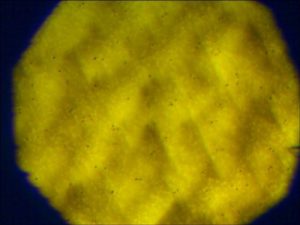
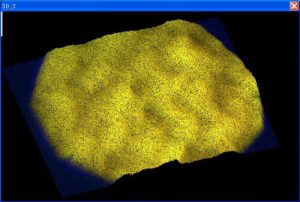
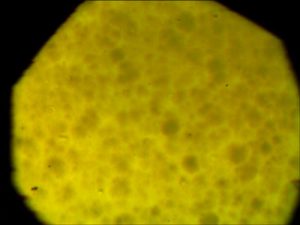
In summary, the Tao ChunKanand and his colleagues at Nanjing University of Science and Technology successfully developed a relatively fast imaging method based on the sub-dark field illumination. To actualize their work, they applied it in determining the fine detail image and three-dimensional profile of a test surface sample. It was worth noting that the obtained fine detailed images existed in pairs while all the images observed were of true colors. Altogether, the study provides vital information that will further pave way for developing more advanced white-light interferometers technologies suitable for numerous applications in different fields.

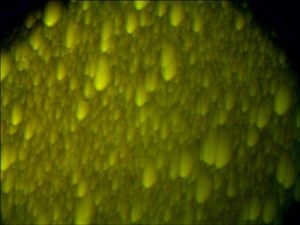
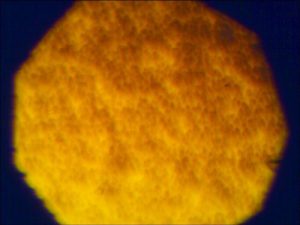
Fig.2 FDI also for the HVPE GaN sample above.











Reference
Tao, C., Wu, Y., Wang, W., Qian, Y., Tao, R., & Kang, T. (2019). Experimental investigation of white-light interferometry based on sub-dark-field illumination. Optics Communications, 435, 108-117.
Go To Optics Communications