 Advances in Engineering Advances in Engineering features breaking research judged by Advances in Engineering advisory team to be of key importance in the Engineering field. Papers are selected from over 10,000 published each week from most peer reviewed journals.

Significance
Plastic waste including polyethylene continues to pile up everywhere—from landfills to riverbanks to the middle of the oceans. And while we like to think recycling has this under control, the truth is, it barely scratches the surface. Mechanical recycling, for all its good intentions, just doesn’t hold up when you look at it practically. Every time plastic goes through the process, it comes out weaker, less useful, and eventually ends up as waste again. The cycle is inefficient and, frankly, a bit of a dead end. This is why chemical recycling has been gaining serious attention. At least in theory, it offers a way to break plastics down into something useful—something that could re-enter the economy without compromising quality. Catalytic pyrolysis, in particular, holds promise because it can turn these stubborn polymers into valuable hydrocarbons. But anyone who has worked in this space knows the gap between theory and application is wide. Catalysts don’t perform as neatly in real-world conditions as they do on paper. They produce a messy soup of compounds, and you spend more time and money cleaning it up than the product is worth.
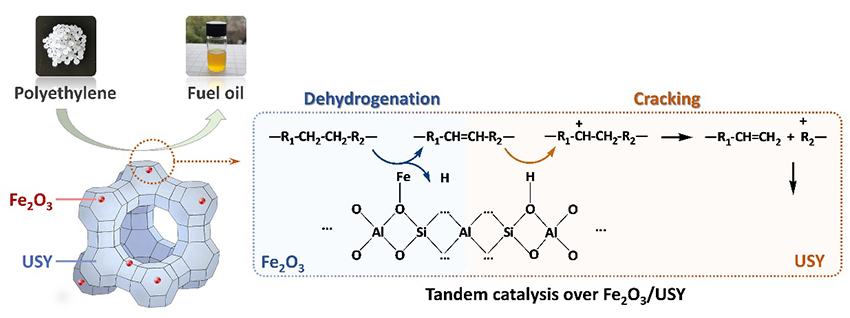
To this account, new research paper published in Journal of the Energy Institute and conducted by Dr. Zezhou Chen from Huzhou University together with Dr. Barry J. Erwin from Avangard Innovative and Dr. Lei Che from the Eco Environmental Technology Co. Ltd, designed a catalyst focused on a combination of iron oxide (Fe₂O₃) and USY zeolite. Why? Because Fe₂O₃ has a knack for pulling hydrogen atoms off hydrocarbons—perfect for generating olefin intermediates. And USY? Its acidic sites excel at breaking those intermediates down further, ideally into the fuel-range hydrocarbons we actually want. The innovation can turn plastic waste directly into usable fuel, without the long trail of expensive processing afterward
The authors started by carefully preparing the catalysts, methodically varying the amount of iron oxide loaded onto USY zeolite supports. Now, this wasn’t an arbitrary experimental detail—it’s well understood that the silicon-to-aluminum (Si/Al) ratio of the zeolite plays a critical role in controlling acidity, which, in turn, governs the cracking behavior of these systems. Too much acidity, and you end up favoring gas production at the expense of valuable liquid fuels. Too little, and the polymer chains simply don’t break down efficiently. So, their task was to find that sweet spot—a balance where the system encourages just enough cracking to maximize liquid fuel yield without tipping the reaction toward over-cracking. With the catalysts ready, they moved on to the pyrolysis experiments. Using a vertical quartz tube reactor, polyethylene pellets were subjected to temperatures in the range of 450 to 460°C under a nitrogen atmosphere. This setup was designed to avoid any unwanted oxidation that could complicate the reaction pathways. Early results were telling. It became obvious that acidity had a direct and measurable impact on product distribution. When the Fe₂O₃/USY catalyst was optimized to a Si/Al ratio of 80 with a 5% iron loading, the oil yield reached an impressive 78.1%. But yield wasn’t the only story here. The oil produced under these conditions was rich in light hydrocarbons—exactly the kind of fractions you’d expect in the gasoline range (C5–C9). And notably, over 71% of the product consisted of olefins, pointing to the key role of the iron oxide component in driving dehydrogenation during the process. To understand whether this performance was due to the unique structure of their bifunctional catalyst or simply the sum of its parts, the team ran comparative tests. They physically mixed Fe₂O₃ and USY without integrating them structurally. The authors found that these physically mixed systems consistently produced lower oil yields and left behind more heavy wax residues. This clearly demonstrated that close, structural contact between the metal and acid sites is crucial for promoting efficient tandem reactions. Follow-up analyses using ¹H NMR and GC-MS backed this up. The oils derived from the integrated Fe₂O₃/USY catalysts contained a higher proportion of light, high-octane hydrocarbons, making them far more suitable for direct use as fuel without extensive downstream refining.
In conclusion, it’s clear that the work of Dr. Zezhou Chen and colleagues an advancement in making plastic waste into valuable liquid fuels. This isn’t just about publishing another catalytic study; it’s about tackling one of the most stubborn environmental challenges with a solution that’s both technically sound and industrially relevant. By demonstrating that a carefully engineered Fe₂O₃/USY catalyst can reliably convert polyethylene waste into high-quality fuels, the team provides a much-needed alternative to waste management strategies that have largely fallen short—mechanical recycling that weakens material properties after each cycle, and incineration methods that simply shift the problem from land to air through emissions. What makes these findings stand out is not just the impressive oil yields but the level of control the team achieved over the reaction pathway. Successfully applying olefin-intermediate tandem catalysis represents a step forward in managing the complex chemistry involved in plastic upcycling. For years, researchers have struggled to design catalyst systems that could handle multiple reaction steps with any real precision. This study not only clarifies how metal and acid sites contribute distinct but complementary roles, it also lays out a blueprint for designing future bifunctional catalysts that can guide these reactions with remarkable selectivity. In a field known for unpredictable outcomes and product streams that often require heavy post-processing, that kind of control is a rare achievement. The industrial implications are equally important. Producing liquid fuels rich in gasoline-range hydrocarbons directly addresses two critical challenges: reducing dependence on fossil fuels and finding a scalable outlet for low-value plastic waste. The fact that the produced pyrolysis oils closely match existing fuel specifications means they could be integrated into current energy infrastructure with little need for costly adjustments. That kind of compatibility isn’t just a technical win—it makes the business case for this technology far more attractive. Turning what is essentially environmental liability into a profitable fuel stream opens the door for real-world investment and adoption. And in a world grappling with both a plastic crisis and an ongoing energy transition, solutions like this are exactly what’s needed.

Reference
Zezhou Chen, Barry J. Erwin, Lei Che, Recycling the polyethylene into fuels via an olefin-intermediate tandem catalysis over Fe2O3/USY catalysts, Journal of the Energy Institute, Volume 116, 2024, 101748,
