Advances in Engineering Advances in Engineering features breaking research judged by Advances in Engineering advisory team to be of key importance in the Engineering field. Papers are selected from over 10,000 published each week from most peer reviewed journals.

Significance
Materials that exhibit emission variation in response to heat, light and mechanical action have enjoyed increased attention in industry. These materials are capable of altering their crystal structure in response to various external stimuli thus making them extremely important for application in memory and switching devices. Most notably, aminoquinoline derivatives have exhibited desired polymorphism and have been observed to undergo mechanically and thermally induced crystal phase transformations accompanied by emission color alterations. For the quinoline, six molecular structures possessing varying emission properties can be derived. These multitude of crystal structures is made possible by the existence of four rotational isomers due to the presence of quinoline and MeO-substituted benzene rings, which are also involved in numerous weak intermolecular interactions.
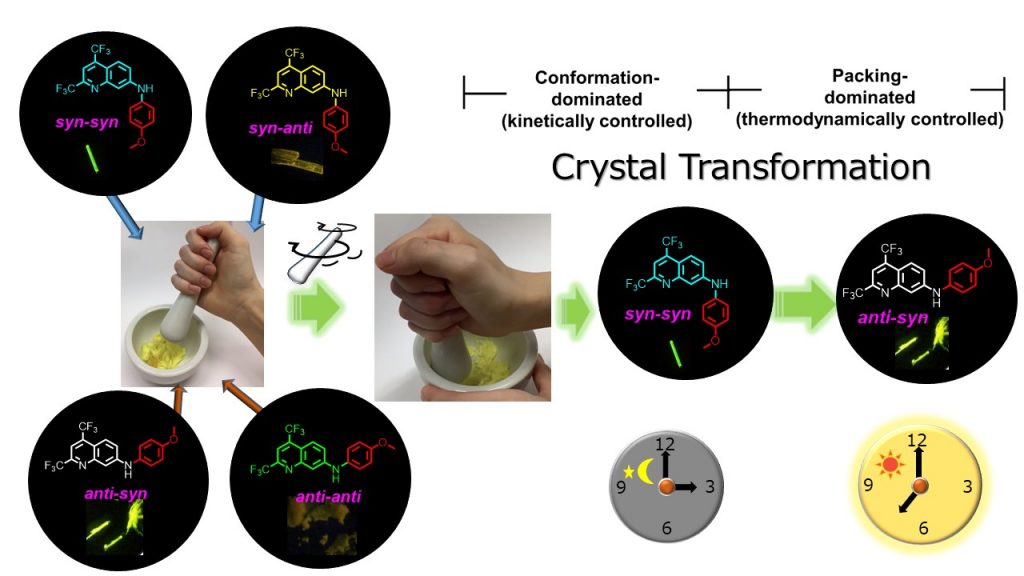
Researchers led by professor Satoru Karasawa at Showa Pharmaceutical University (belonging to Kyushu University by March 2017) in Japan, proposed a two-step transformation of p-anisolylaminoquinoline derivatives induced by conformation- and packing-dominated processes. They hoped to demonstrate this transformation by featuring a mechanically induced first step and subsequent self-transforming at ambient conditions. Their work is published in the research journal, Dyes & Pigments.
In their studies six polymorphs of an emissive quinoline derivative were made to undergo a two-step transformation. The team succeeded in this by ensuring that the first step was due to conformation dominated process while the second was as a result of packing dominated processes. This was confirmed by observing the changes of the corresponding emission properties and powder X-ray diffraction patterns. Eventually, the researchers ground the crystals and left them for several hours so as to undergo the spontaneous transformations in order to yield the final polymorph.
The authors observed that in the case of the mechanically induced transformations, all crystals were converted to a syn-anti isomer (2a), which was the most thermodynamically stable isomer among the four isomers. The team also noted that despite the diverse packing styles of (pseudo)polymorphs, their mechanically induced transformations reflected stability at the monomer level, proceeding through an amorphous state and resulting in a conformation-dominated process at the molecular level.
The study reported by Satoru Karasawa and his research team has aided reveal that the crystals of polymorphs 1-4 exhibit multiple transformations accompanied by emission changes, with a transformation of the metastable super-cooled liquid state being observed. This work has also shown that polymorph 3 had the highest melting point among all polymorphs, although the corresponding difference was slight. In conclusion, the mechanically induced transformation is temporary, and the resulting ground 2a (syn-anti isomer) represents a metastable state. The spontaneous self-transformation accelerated by heating is a thermodynamically controlled process, and the produced 3 (anti-syn polymorphs) corresponds to the most thermodynamically stable polymorph. These novel stimuli-responsive materials can pave a new way to develop new and more efficient memory and switching devices, changing the paradigm of information storage and retrieval.
Reference
Ryusuke Hagihara, Kazuteru Usui, Satoru Karasawa. Two-step transformation of p-anisolylaminoquinoline derivatives induced by conformation- and packing-dominated processes. Dyes and Pigments, volume 143 (2017) pages 401-408
Go To Dyes and Pigments