 Advances in Engineering Advances in Engineering features breaking research judged by Advances in Engineering advisory team to be of key importance in the Engineering field. Papers are selected from over 10,000 published each week from most peer reviewed journals.

Significance Statement
Separating emulsified water from oil in the presence of surfactants appears to be challenging. A typical example of such is to remove water from ultra-low sulfur diesel fuel with additives including, lubricants, cetane improver as well as fuel injector detergent. Water along with other water-based fuel impurities may lead to filter plugging, damage of engine components, fuel starvation and microbiological growths. Therefore, removing them present a critical component in advanced engine protection.
Coalescence separation of emulsified water implementing a coalescence filter made of packed non-woven fibers treated with selected chemicals is an economical approach. Unfortunately, the working of a coalescer is normally challenged by the presence of surfactants through the reduction of water-oil interfacial tension forming stable emulsions and through surfactant adsorption on coalescence material that changes the surface wettability with regards to water or oil.
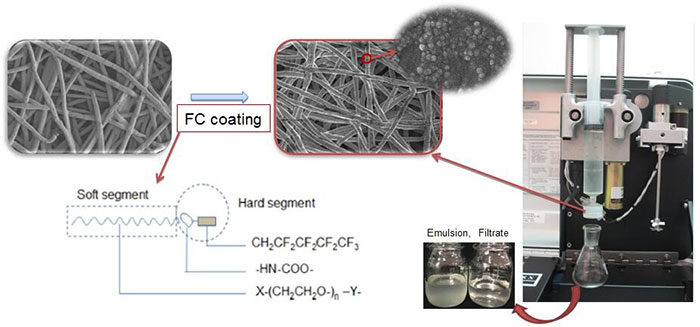
Researchers led by Professor Chuanfang Yang at Key Laboratory of Green Process & Engineering and State Key Laboratory of Biochemical Engineering, Institute of Process Engineering from Chinese Academy of Sciences came across a unique fluorochemical coating that exhibited unique behavior in response to water wetting under diesel fuels containing monoolein as a surfactant. They then applied the coating to treat a commercial stainless steel fiber felt to remove water-in-fuel emulsions via coalescence. Their research work is now published in Separation and Purification Technology.
The authors performed coalescence experiments using the original stainless steel fiber felt. The felt was dip-coated with an emulsion containing solid and oven cured at 120 °C. They added precisely 50µm pure water to 50 ml diesel fuel. The mixture was then stirred for about 30 seconds at 25000 rpm forming an emulsion. The 50ml emulsion was then pushed through the filter for approximately 40 seconds. They collected the filtrate and let it settle for a minute. They took 10ml sample at the middle of the collector for testing to determine the amount of unseparated water.
Among the coatings used, fluorochemical was found to behave differently when compared to other coatings since it allowed water to wet out the surface when monoolein was present in fuel. This coating was observed to enhance coalescence separation efficiency of monoolein stabilized-in-water fuel emulsions. Instrumental analyses indicated that the coating had a spherical island morphology that possessed both water repellency and affinity in a single chemistry. This was an ideal attribute, which can be imparted to a coalescence filter medium for water droplet capture and release.
The researchers found that the coating also adsorbed monoolein intensively. This was a counter intuitive phenomenon that aided coalescence. This mechanism was speculated based on experimental observation using two water droplets and it was revealed the wetting out of the coating surface in the presence of a surfactant by the first droplet plays an important role.
The outcomes of this research will be implemented as guidelines for the design and development of coalescence materials to take care of the difficult separation problems of surfactant containing water-in-oil emulsions.




Reference
Yanxiang Li, Lixia Cao, Dan Hu, Chuanfang Yang. Uncommon wetting on a special coating and its relevance to coalescence separation of emulsified water from diesel fuel. Separation and Purification Technology, volume 176 (2017), pages 313–322.
Go To Separation and Purification Technology