 Advances in Engineering Advances in Engineering features breaking research judged by Advances in Engineering advisory team to be of key importance in the Engineering field. Papers are selected from over 10,000 published each week from most peer reviewed journals.

Significance
Aircraft engines operating in dusty or sandy environments are exposed to solid particles carried by the incoming air. When particles strike compressor blades at high speeds, they gradually wear away the blade surfaces, change their shape and disturb the airflow and this can increase aerodynamic losses and reduce compressor performance, especially during takeoff and landing in desert environments, when engines may encounter large amounts of airborne sand.
Predicting erosion is complex because blade damage and airflow influence each other. Changes in blade geometry affect where particles strike the surface and at what angles, which can influence how much material is removed during subsequent collisions. The rate and distribution of erosion can vary over time. Many numerical studies estimate erosion using a fixed blade shape or assume that material is removed at a constant rate and these methods can predict surface damage but do not fully account for how progressive wear affects particle impacts and airflow.
The effects of erosion are more complex near the blade tip, where air passes through the narrow gap between the blade and surrounding casing. The pressure difference across the blade drives this leakage flow, creating vortices that interact with the main airflow. Aerodynamic losses also occur in the boundary layer, a thin region of slower-moving air along the blade surface. Progressive erosion can affect both leakage flow and boundary-layer development, but the extent of these changes is not fully understood.
In a recent research paper published in Aerospace Science and Technology, Yunyu Wang, Kunbin Jin, Linfei Yang, and Professor Jiaqi Luo from Zhejiang University, together with Professor Zuoli Xiao from Peking University, investigated these interactions in a high-loading compressor cascade. They developed a numerical method that combines airflow simulation, particle tracking, erosion prediction, and dynamic mesh deformation to study how progressive blade wear affects aerodynamic performance.
Experiments and Findings
The simulation covered 20 hours of particle erosion, with the blade surface updated at successive stages to account for material removal. After each update, the airflow and particle trajectories were recalculated using the modified geometry. This allowed the team to examine how erosion developed as the blade shape changed.
Wang, Jin, Yang, Luo, and Xiao evaluated numerical methods against experimental measurements before the erosion analysis. They found the predictions of blade surface pressure and airflow patterns agreed well with experimental observations. They also tested the erosion model using measurements from particle-laden flow through an elbow pipe and reproduced the general distribution of material removal.
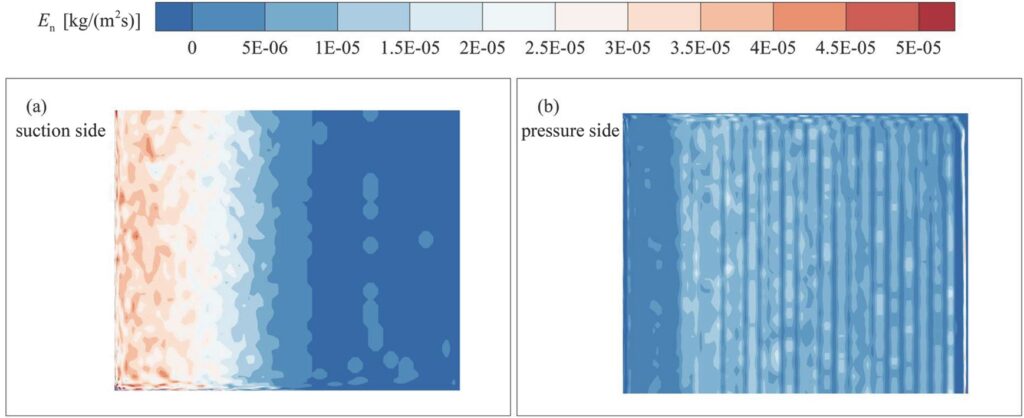
Particle tracking showed different erosion patterns on the two sides of the compressor blade. On the suction surface, particles struck the leading edge with high momentum, causing concentrated damage. Farther downstream, smaller impact angles reduced material removal. Erosion on the pressure surface was less severe but covered a larger area, mainly because particles rebounded from the opposite blade surface.
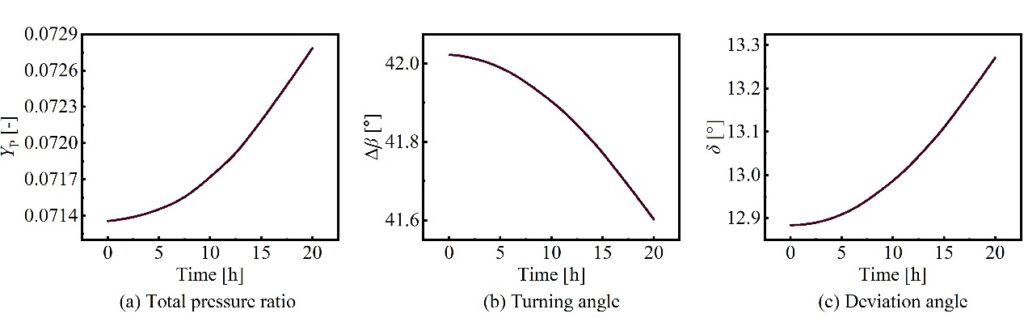
As the leading edge wore away, the area exposed to particle impacts became smaller, concentrating subsequent collisions and increasing the rate of material removal. After 20 hours, the erosion rate near the suction-side leading edge had increased by approximately 21.1%. Simulations assuming a constant erosion rate underestimated the aerodynamic losses because they did not account for how erosion intensified over time.
The changing blade geometry also affected compressor performance. The total-pressure-loss coefficient increased by approximately 2%, accompanied by greater flow blockage and changes in the direction of the exiting airflow. To identify the sources of these losses, the team separately evaluated the contributions of the boundary layer, leakage vortex, and flow mixing.
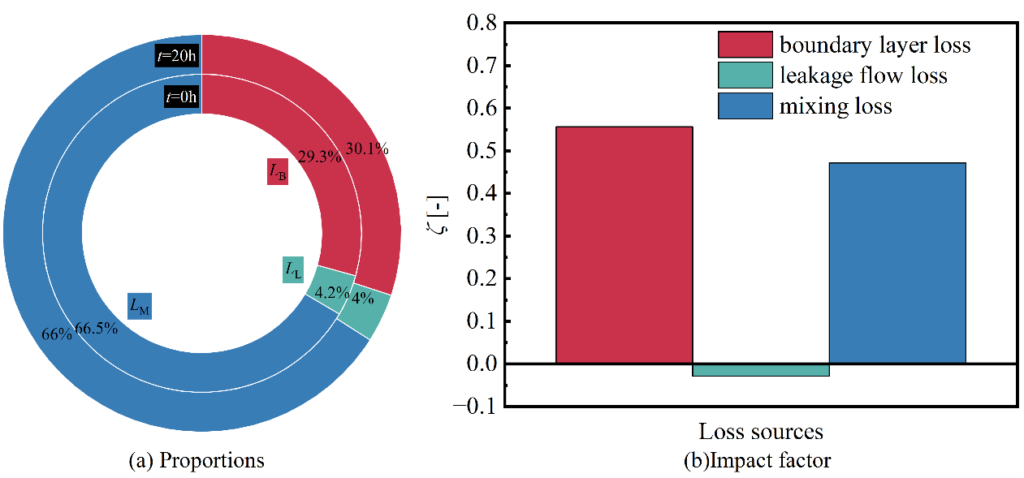
The authors observed boundary-layer loss increased by 7.5%, which make it the largest contributor to the deterioration in aerodynamic performance. Mixing losses also increased, although losses associated with the leakage vortex decreased. Mixing remained the largest source of total aerodynamic loss, but changes in the boundary layer accounted for most of the additional losses caused by erosion.
The behavior of the leakage vortex helped explain this difference. Erosion altered the pressure distribution along the blade tip, reducing pressure loading near the leading edge and weakening the concentrated vortex core. Farther downstream, increased pressure loading strengthened the surrounding vortex sheet and its interaction with the main airflow. Mixing losses increased despite the reduction in vortex-core strength.
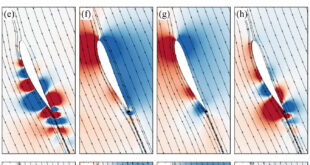
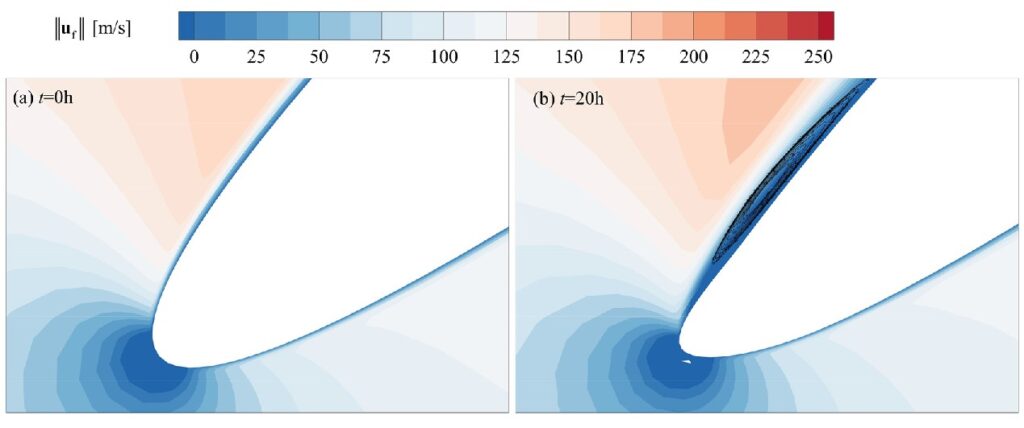
Changes in the boundary layer followed a different pattern. Erosion created a region of recirculating airflow near the suction-side leading edge, associated with an adverse pressure gradient and local flow separation. This affected the flow farther downstream, promoting an earlier transition to turbulence and greater separation near the trailing edge. The boundary layer also became thicker, contributing to increased blockage and viscous energy dissipation.
Engineering Significance
The new study provides a way to assess how compressor blades deteriorate during prolonged exposure to particle-laden airflow and by accounting for the changing blade shape throughout the erosion process, the numerical method can capture variations in aerodynamic performance that may be missed when erosion is treated as a constant process.
The analysis showed that the flow mechanisms responsible for the largest aerodynamic losses were not necessarily those most affected by erosion. Flow mixing accounted for the largest share of total losses, but changes in the boundary layer contributed most to the decline in compressor performance as blade erosion progressed.
The findings also suggest that the location of erosion can be as important as the amount of material removed. Damage concentrated near the leading edge can alter airflow farther downstream, affecting separation and energy dissipation across a larger portion of the blade. The reported method in the study helps engineers identify which areas of blade wear have the greatest effect on airflow and compressor performance. It also provides a better understanding of how compressors deteriorate over time when operating in environments containing airborne particles.
Reference
Yunyu Wang, Kunbin Jin, Linfei Yang, Zuoli Xiao, Jiaqi Luo, Numerical study of flow and particle erosion co-evolution in a high-loading compressor cascade, Aerospace Science and Technology, Volume 170, 2026, 111525,
Go to Aerospace Science and Technology