Advances in Engineering Advances in Engineering features breaking research judged by Advances in Engineering advisory team to be of key importance in the Engineering field. Papers are selected from over 10,000 published each week from most peer reviewed journals.

Significance
Current global trends widely involve campaigns oriented towards sustainable use of materials. A shift towards the adoption of fiber-reinforced composites in major load bearing applications has been witnessed. Unfortunately, the end-of-life options for these materials are often lacking sustainability. Thermoplastic composites based on thermotropic liquid crystalline polymer (LCP) materials are interesting candidates for reinforced composite application due to their promising mechanical performance and potential for recyclability. Combining LCPs’ invaluable attributes with current societal push toward the more sustainable use of materials, these materials warrant new interest in the aforementioned class of composites. Consequently, numerous studies have been performed in the past; however, a coherent set of design rules for LCP design for the generation of injection-molded reinforced thermoplastic composites is not yet available; likely due to the complex interplay between LCP and matrix components.
To identify critical LCP properties required for effective LCP reinforcement in shear-flow fields, it is imperative that further research be implemented. In this context, a research team from the Aachen-Maastricht Institute of Bio-Based Materials at Maastricht University: Gijs de Kort (PhD candidate), Professor Sanjay Rastogi and Professor Carolus Wilsens assessed the influence of the LCP flow behavior and its thermal dependence on the morphological development in LCP/PLLA blends during and after processing. Their focus was on the critical parameters for the morphological development and mechanical performance of LCP-reinforced composites. Their work is currently published in the research journal, Macromolecules.
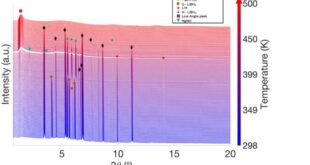
In particular, the research team evaluated the behavior of two different LCPs which could be processed at relatively low temperatures; the first LCP was the commercially available, aromatic copolymer Vectra LCP V400P (LCP-A), whereas the other was an in-house synthesized semiflexible LCP (LCP-B) having both aliphatic and aromatic comonomers and exhibited a significantly enhanced relaxation compared to its aromatic counterpart. Further, the morphological development of the LCP components in the PLLA matrix was assessed during processing via two different processing routes. Eventually, the mechanical performance of the generated products was evaluated and correlated to the orientation parameter determined through wide-angle X-ray diffraction.
In so doing, the researchers demonstrated that both the matrix viscosity and viscosity ratio between the dispersed and matrix phase, determined the deformation and breakup of the dispersed LCP droplets during extrusion. In addition, they were able to establish that the thermal dependence of the viscosity ratio was a critical parameter for the composite performance after injection molding.
In summary, blends of two different thermotropic LCPs in PLLA were produced and the effect of the chosen processing routes evaluated in terms of LCP morphology, LCP orientation, and composite mechanical properties. Remarkably, their approach led to the development of several design rules that could be generated for the development of LCP materials for injection molding of thermoplastic LCP/PLLA blends. Overall, the findings of Maastricht University scientists provide valuable insights in the morphological development of LCP-reinforced blends, highlighting the importance of the development of viscoelastic properties as a function of temperature, and provide guidelines for the design of new LCP polymers and their thermoplastic composites.
“Understanding of the morphology development in LCP/PLA blends and the establishment of design rules proved beneficial not only for the development of thermoplastic composites, but also for their mechanical reprocessing without loss of properties” said Professor Carolus Wilsens, in a statement to Advances in Engineering.



Reference
Gijs W. de Kort, Sanjay Rastogi, Carolus H. R. M. Wilsens. Controlling Processing, Morphology, and Mechanical Performance in Blends of Polylactide and Thermotropic Polyesters. Macromolecules 2019, volume 52, page 6005−6017.