Advances in Engineering Advances in Engineering features breaking research judged by Advances in Engineering advisory team to be of key importance in the Engineering field. Papers are selected from over 10,000 published each week from most peer reviewed journals.

Significance
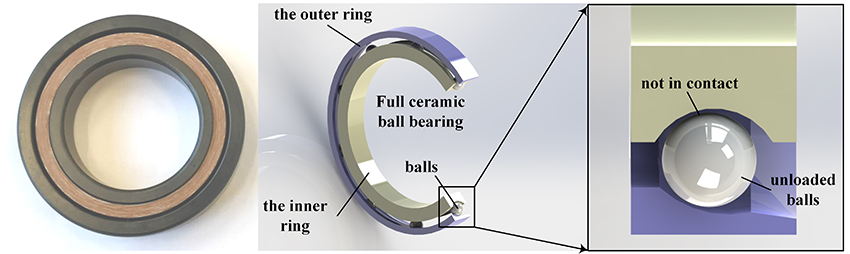
Ball bearings are often used to enhance the performance of various complex conditions, particularly those involving rotation movement. However, ball bearings require proper and regular lubrication to work efficiently. Lubrication helps prevent friction and subsequent temperature rise between the balls and rings. There are several types of ball bearings, including steel and full ceramic ball bearings. Ball bearings are generally susceptible to failures induced by poor lubrication conditions. These failures may lead to performance degradation and even damage due to uneven loading conditions that bring about the local overhead in the load. This calls for effective monitoring of the uneven loading condition. Despite the significant research efforts, dynamic behaviors of rolling bearings due to uneven loading conditions have not been fully explored. Moreover, the available models are mainly based on steel bearings.
Recent findings have revealed that under insufficient lubrication, the contact forces between the balls and the rings are highly affected by the decrease in the thickness in the oil film than the friction forces. Moreover, the difference in the diameters of the ceramic ball bearings exhibits a significant influence on the interaction between the bearing components. Equipped with this knowledge, Professor H.T. Shi and Professor X.T. Bai from Shenyang Jianzhu University developed dynamic model for monitoring the uneven loading conditions in full ceramic ball bearings in starved lubrication considering the effects of the ball diameter differences. Their main object was to extract and investigate in detail the features of the uneven loading conditions. The work is currently published in the journal, Mechanical Systems and Signal Processing.
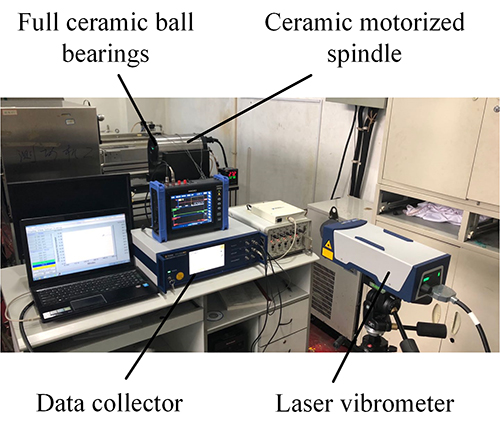
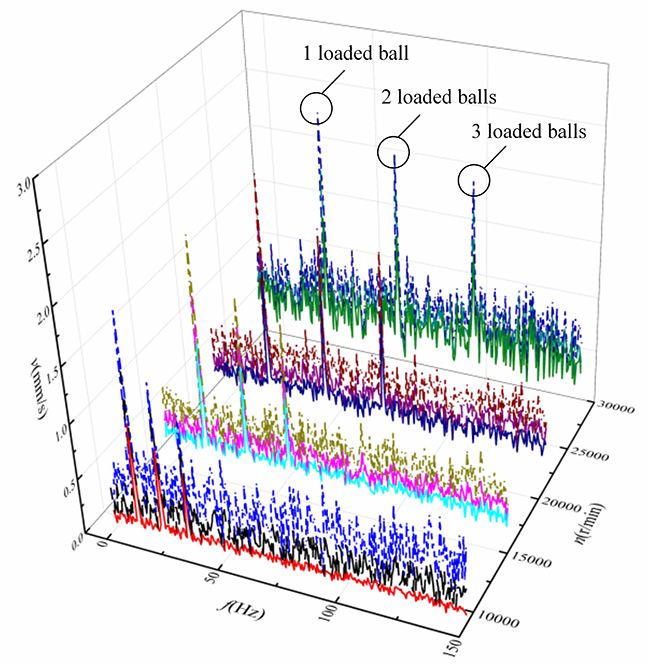
In their approach, the authors used model-based calculations coupled with signal acquisition and conditional recognition to monitor the conditions. A simulation, in which the number of loaded balls and the contact between the balls and the rings was analyzed based on the working and loading conditions, was conducted to derive the characteristic frequencies. Furthermore, the vibration of the inner rings was analyzed in the frequency domain using the amplitudes of the frequencies as the indicators. Finally, the model was validated by comparing the monitoring results with the theoretical predictions.
The authors identified ball parameter tolerances and ball arrangements as the main factors affecting the uneven loading conditions. Moreover, the unloading conditions could be effectively monitored and evaluated through the amplitudes of the peak frequencies using the amplitude ratios as the indicators for the unloading conditions and vibration intensity. The trends in the uneven loading conditions were successfully verified through theoretical analysis. The monitored results agreed well with the theoretical predictions.
In a nutshell, the researchers presented a dynamic based mode for monitoring the uneven loading conditions of full ceramic ball bearings in starved lubrication. The loading conditions were observed to change with changes in the ball diameter tolerances and adjacent ball diameter differences. The approach was successfully verified through theoretical analysis in which the monitoring results fitted well with the theoretical predictions. In a statement to Advances in Engineering, the authors noted that the study would provide a foundation for efficient monitoring of the working conditions of ball bearings and their maintenance.


Reference
Shi, H., & Bai, X. (2020). Model-based uneven loading condition monitoring of full ceramic ball bearings in starved lubrication. Mechanical Systems and Signal Processing, 139, 106583.