 Advances in Engineering Advances in Engineering features breaking research judged by Advances in Engineering advisory team to be of key importance in the Engineering field. Papers are selected from over 10,000 published each week from most peer reviewed journals.

significance statement
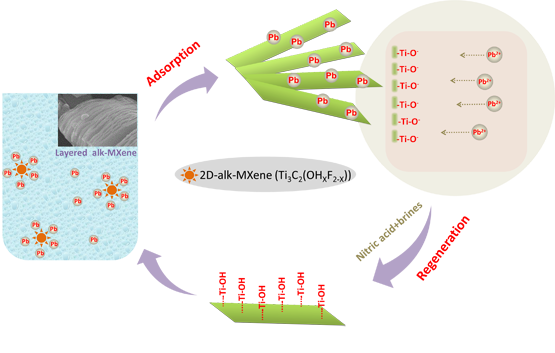
Proper morphologies and functional groups on the surface of the known functional materials in many cases play critical roles in exploring their novel properties. Recently, Prof. Qiuming Peng and Qingrui Zhang from Yanshan University, China offer a facile fabrication of hierarchical 2D-MXene materials by simple HF exfoliation and alkalization process for environmental remediation firstly. The layered structure and abundance in activated Ti−OH sites offer potential applications toward Pb(II) purification with maximum calculated sorption capacities of 2800mg/g. Moreover, The alk-MXene exhibits large sorption capacities, fast kinetic, extremely trace Pb(II) effluent, and reversible adsorption properties. The method is highlighted by its simplicity and high-yield production of a well-defined morphology, which is promising industrial merits.
Environmemtal application by advanced materials represents the significant pathway to trace pollutants sequestration in waters. Peng and Zhang extend the MXene materials applicability to heavy metal retention. such discovery is an inspiring landmark for both MXene and water treatments. In the future, it is possible to cast the alk-MXene into desired waters for deep purification after initial chemical precipitation treatments, instead of the expensive membrane technology and complicated ion-exchange operation. Commercialization of alk-MXene will be an important step to illuminate environmental restoration in future.
Am. Chem. Soc.,2014,136 (11), pp 4113–4116.
Qiuming Peng *†, Jianxin Guo †, Qingrui Zhang *‡,Jianyong Xiang †, Baozhong Liu §, Aiguo Zhou §,Riping Liu †, Yongjun Tian †
†State Key Laboratory of Metastable Materials Science and Technology, ‡Hebei Key Laboratory of Applied Chemistry, School of Environmental and Chemical Engineering, Yanshan University, Qinhuangdao 066004,PR China and
§School of Materials Science and Engineering,Henan Polytechnic University, Jiaozuo 454000, PR China.
Abstract
The functional groups and site interactions on the surfaces of two-dimensional (2D) layered titanium carbide can be tailored to attain some extraordinary physical properties. Herein a 2D alk-MXene (Ti3C2(OH/ONa)xF2–x) material, prepared by chemical exfoliation followed by alkalization intercalation, exhibits preferential Pb(II) sorption behavior when competing cations (Ca(II)/Mg(II)) coexisted at high levels. Kinetic tests show that the sorption equilibrium is achieved in as short a time as 120 s. Attractively, the alk-MXene presents efficient Pb(II) uptake performance with the applied sorption capacities of 4500 kg water per alk-MXene, and the effluent Pb(II) contents are below the drinking water standard recommended by the World Health Organization (10 ug/L). Experimental and computational studies suggest that the sorption behavior is related to the hydroxyl groups in activated Ti sites, where Pb(II) ion exchange is facilitated by the formation of a hexagonal potential trap.
Copyright © 2014 American Chemical Society.
