Advances in Engineering Advances in Engineering features breaking research judged by Advances in Engineering advisory team to be of key importance in the Engineering field. Papers are selected from over 10,000 published each week from most peer reviewed journals.

Significance
Lithium alloying and dealloying reactions underpin both energy storage and materials science, serving as the working principle behind high-capacity battery electrodes and as a strategy to fabricate porous metallic structures. Yet, while the electrochemistry of these processes has been studied extensively, their mechanical underpinnings—particularly the role of externally applied pressure—remain poorly understood. This gap is striking given that alloy-type anodes such as silicon, tin, indium, and aluminum undergo enormous volume changes, often exceeding 200%, during lithiation and delithiation. These transformations produce porosity, fractures, and contact loss, undermining electrode stability. For liquid electrolyte systems, dealloying frequently yields bicontinuous nanoporous structures through the interplay of percolation dissolution and surface diffusion. In solid-state systems, however, the evolution of morphology under applied stack pressure is more complex, largely because of the absence of liquid-phase transport and the intimate role of solid–solid interfaces.
The rapid ascent of solid-state batteries (SSBs) as candidates for safer, higher-energy-density storage has magnified the urgency of this question. Alloy anodes promise exceptional specific capacities but suffer from severe chemo-mechanical instability that impedes their practical adoption. Without controlled densification, electrodes experience porosity formation, interfacial detachment, and lithium trapping, all of which reduce reversibility and capacity retention. Previous studies of lithium metal electrodes revealed that applied stack pressure can suppress dendrite growth and promote denser morphologies. However, whether similar principles apply to lithium alloy systems has not been systematically addressed.
A key limitation of earlier investigations is that they often treated pressure as a fixed or incidental variable rather than as a mechanistic driver of structural evolution. Consequently, no universal framework exists for predicting how different alloys respond to mechanical loading during cycling. Given the wide variations in yield strength among candidate anode metals, from the softness of indium to the rigidity of aluminum and silicon, the absence of such a framework has left the design of practical SSBs reliant on empirical trial and error.
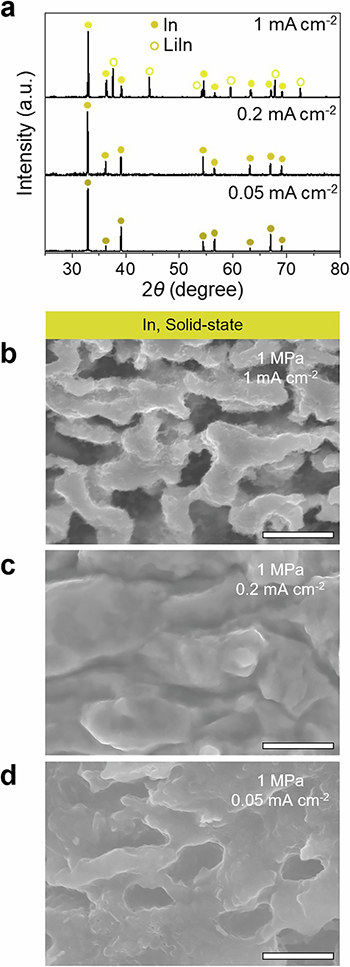
To this account, new research paper published in Nature Materials and conducted by Congcheng Wang, Yuhgene Liu, Won Joon Jeong, Timothy Chen, Mu Lu, Douglas Lars Nelson, Elif Pınar Alsaç, Sun Geun Yoon, Kelsey Anne Cavallaro, Sazol Das, Diptarka Majumdar, Rajesh Gopalaswamy, Shuman Xia & led by Professor Matthew T. McDowell from the Georgia Institute of Technology, the researchers developed two complementary models: a universal scaling framework linking porosity evolution during lithium dealloying to the applied stack pressure normalized by yield strength, and a bilayer electrode design that exploits indium’s low densification stress to stabilize harder alloys. The first model establishes a predictive rule—densification and stable cycling occur above ~0.2σy—for a wide range of metallic anodes. The second introduces engineered interfaces that lower pressure requirements, enabling practical cycling of Al and Si at 2–5 MPa. Together, these advances bridge mechanics and electrochemistry, paving the way for deployable solid-state batteries. To address these challenges, the team selected aluminum, tin, and indium foils as representative alloying systems and silicon wafers as a brittle counterpart. Half-cells were assembled with either a conventional carbonate liquid electrolyte or a sulfide solid-state electrolyte (Li6PS5Cl). By applying stack pressures ranging from sub-megapascal values up to 30 MPa, the researchers could systematically probe the morphological evolution of electrodes during lithiation and delithiation. For alloying tests, galvanostatic lithiation was performed until full transformation into LiAl, Li7Sn2, or Li13In3 was achieved. Cross-sectional SEM images revealed a stark dependence on applied pressure: at low stack pressures (≤2 MPa), liquid electrolyte systems exhibited severe fracture and porosity due to non-uniform expansion. In contrast, high pressures yielded compact morphologies with flat alloy–metal interfaces. Solid-state cells showed fewer fractures at low pressures, though interfacial contact loss still manifested in elevated overpotentials and reduced capacity. Quantification of thickness changes demonstrated that at sufficiently high stack pressures, the expansion matched theoretical molar volume predictions, confirming densification.
Dealloying experiments further underscored the importance of pressure. Potentiostatic delithiation at 0.38 V revealed bicontinuous porous structures at low pressures across all three metals, analogous to classical dealloyed noble metals. Increasing the pressure gradually collapsed these porous frameworks, and above a critical point, fully densified structures emerged. The researchers discovered that this critical pressure consistently scaled with approximately 20% of each metal’s yield strength. When normalized by yield strength, the relative densities of Al, Sn, and In converged onto a universal curve describable by Gibson–Ashby scaling laws for porous solids.
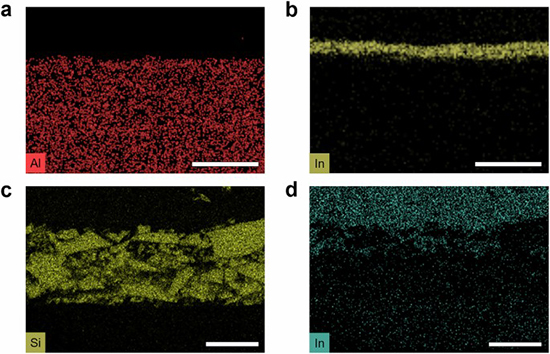
Silicon exhibited markedly different behavior. Instead of bicontinuous porosity, lithiation produced columnar cracking patterns, with vertical fractures dominating at higher pressures. These cracks limited densification to about 70–80% relative density, regardless of further pressure increase. Nonetheless, higher pressures still reduced lithium trapping by maintaining more continuous interfacial contact. Full-cell tests with NMC622 cathodes revealed the electrochemical implications of these morphological trends. For metallic anodes, cycling stability and capacity retention improved dramatically once the applied pressure exceeded the yield-strength-scaled threshold. At subcritical pressures, capacity decayed rapidly due to interfacial detachment and porous degradation. For silicon, stable cycling only emerged above ~20 MPa, when vertical cracking reduced lithium trapping. Finally, the group engineered bilayer anodes by depositing a thin indium interfacial layer on Al and Si electrodes. This design capitalized on indium’s low densification stress, enabling stable, high-capacity cycling at stack pressures as low as 2–5 MPa. Under these conditions, the bilayer electrodes achieved areal capacities exceeding 2 mAh cm⁻² with Coulombic efficiencies above 99.8%, surpassing pure Al or Si anodes under identical pressures.
This study provides a unifying framework for understanding how mechanical pressure dictates morphology and cycling performance in lithium alloy anodes. By establishing that porosity evolution follows universal scaling laws tied to the yield strength of the host metal, the authors supply a predictive tool for evaluating new alloy systems. The identification of a critical threshold at ~0.2σy as the condition for densification bridges mechanical principles with electrochemical outcomes, offering a simple yet powerful design criterion. The implications extend beyond theory. Practically, solid-state batteries face constraints that prevent the application of extreme stack pressures at scale. The pressures commonly used in laboratory demonstrations, often exceeding 50–100 MPa, are unrealistic for commercial cells. Demonstrating that stable cycling can be achieved at 2–5 MPa through interface engineering represents a major advance toward deployable devices. By coating silicon and aluminum with indium, the researchers demonstrated a strategy to decouple electrode stability from bulk mechanical properties, thereby reducing the operational burden without sacrificing capacity. The contrast between metallic and silicon anodes also carries weight. Metals follow plastic-yield-dominated densification, whereas silicon undergoes brittle fracture and crack-driven stabilization. Recognizing these divergent mechanisms ensures that future design efforts can be material-specific rather than relying on generalized assumptions. For example, while indium coatings are beneficial for both systems, their underlying effects differ: promoting densification in metals and mitigating crack-induced contact loss in silicon.
On a broader scale, the work underscores the necessity of integrating mechanics into the electrochemical design of batteries. Energy storage materials are not static; they breathe, fracture, and densify in response to both chemical and mechanical stimuli. A predictive framework that accounts for these interactions offers an avenue to rational electrode design rather than reliance on empirical trial. The study also opens new questions. For instance, will similar scaling behaviors hold for multicomponent alloys with complex phase diagrams? How will long-term cycling under fluctuating stack pressures affect morphology compared with static loads? And could interface engineering strategies be extended to other low-yield-strength metals beyond indium? These avenues hint at fertile ground for further research. Ultimately, the findings mark a step toward practical high-energy SSBs that balance electrochemical ambition with mechanical feasibility. By quantifying and exploiting the role of pressure, the authors provide not only immediate design strategies for silicon and aluminum anodes but also a conceptual foundation applicable across the landscape of alloy-based storage.

Reference
Wang, C., Liu, Y., Jeong, W.J. et al. The influence of pressure on lithium dealloying in solid-state and liquid electrolyte batteries. Nat. Mater. 24, 907–916 (2025). https://doi.org/10.1038/s41563-025-02198-7