Advances in Engineering Advances in Engineering features breaking research judged by Advances in Engineering advisory team to be of key importance in the Engineering field. Papers are selected from over 10,000 published each week from most peer reviewed journals.

Significance
Nanotechnology is a rapidly advancing field that holds tremendous promise for a wide range of applications, including photovoltaics and thermoelectrics. Among the various materials investigated for these applications, copper antimony chalcogenides have garnered significant interest due to their attractive optoelectronic properties and use of less toxic, abundant elements. In a new study published in the peer-reviewed Journal Nano Letters, researchers Dr. Amanda Kale, Dr. William Bullett, and led by Professor Amy Prieto from the Department of Chemistry at Colorado State University reported the synthesis of ternary nanoparticles in the Cu-Sb-Se system. Their study seek to explore phase control through the manipulation of precursor reactivity, opening doors to design new materials for improved nanotechnology applications.
One of the primary challenges in multinary copper chalcogen syntheses is the varying reactivity of cationic precursors. Oftentimes, one cation is more reactive than the other, leading to the formation of binary phases or solid solutions enriched in one cation. To address this issue, researchers have sought to control precursor reactivity through the addition of reagents favoring the formation of more reactive cation complexes. A popular choice for this purpose is lithium bis(trimethylsilylamide) (LiHMDS), which has been used successfully with various synthesis methods. LiHMDS promotes the formation of reactive metal silylamide intermediates, enhancing the likelihood of incorporation into the crystal structure.
To achieve unifying trends in nanoparticle synthesis for designing new materials, it becomes essential to collectively define precursor reactivity. In this context, the authors define precursor reactivity concerning the stability of the active complex formed just before injection. A less stable active complex with easily dissociating leaving groups is considered more reactive, leading to its decomposition and eventual incorporation into the crystal structure.
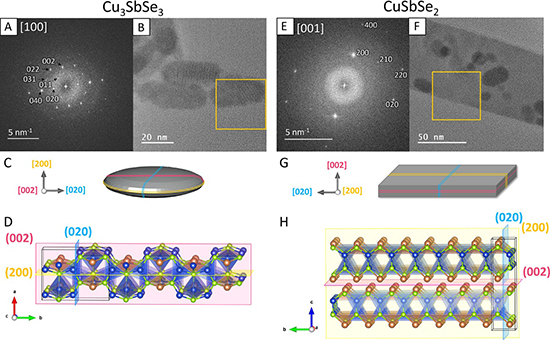
The Cu-Sb-Se system presents an excellent platform for studying the impact of precursor reactivity on phase formation. The system consists of three ternary phases, CuSbSe2, Cu3SbSe3, and Cu3SbSe4, which have shown similar stabilities in solution, posing challenges in some syntheses due to phase impurities. Although all three ternary nanoparticle phases have been synthesized in isolation, the specific synthetic parameters favoring each ternary phase remain unknown.
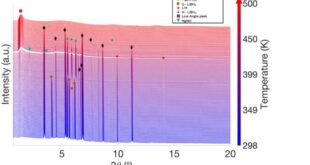
In their investigation, the authors performed Powder X-ray diffraction (PXRD) on the reaction products at various time intervals to trace the phase transformation pathway in the Cu-Sb-Se system. They observed that Cu3SbSe3 predominantly formed initially and subsequently decomposed into thermodynamically stable CuSbSe2 sheets in reactions with oleylamine. The authors explored phase control in the Cu-Sb-Se system through the manipulation of precursor reactivity. To achieve this, the researchers attempted to alter precursor reactivity by adding LiHMDS, intending to bypass the metastable phase and directly nucleate CuSbSe2. They tested the applicability of LiHMDS in controlling reactivity in unexplored chalcogenide systems.
The researchers observed that the addition of LiHMDS indeed increased the rate of conversion from Cu3SbSe3 to CuSbSe2, suggesting that the base enhanced the reactivity of the harder acid Sb3+ in the system. However, they found that despite the presence of the base, Cu3SbSe3 still formed initially, implying that the copper complex remained too reactive for Cu+ and Sb3+ to incorporate at similar rates.
Thermodynamic values were crucial in understanding the phase transformation pathway. CuSbSe2, with the most negative calculated Hf value, was the most stable phase, while Cu3SbSe3 had the most positive Hf value, making it a metastable phase that decomposed to CuSbSe2. This finding was further supported by the formation of Cu3SbSe4 impurities from Cu3SbSe3 particles in certain conditions.
Professor Amy Prieto proposed that the Se precursor played a role in favoring the initial formation of Cu3SbSe3. They noticed that longer Se precursor stirring times resulted in a higher proportion of CuSbSe2, suggesting that the Se precursor’s dissolution affected the rate of phase transformation. Despite the use of amide-promoted syntheses, the researchers faced challenges in achieving direct nucleation of CuSbSe2. They suggested that the Se precursor may be responsible for the initial formation of Cu3SbSe3, and further investigations with the Se precursor could shed more light on this behavior.
In conclusion, the new study represents an important step towards understanding phase control in the Cu-Sb-Se system. The authors’ findings contribute to the exploration of precursor reactivity in nanoparticle synthesis, laying the groundwork for designing new and unexplored materials. The knowledge gained from this study can be extended to other multinary chalcogenide systems, providing valuable insights for enhancing nanotechnology applications in various fields. As researchers continue to decipher the complex interplay of precursor reactivity, nanoparticle synthesis will advance, bringing forth novel materials with enhanced properties and performance.

Reference
Kale AR, Bullett WE, Prieto AL. Controlling Phase Conversion of Cu-Sb-Se Nanoparticles through the Use of an Amide Base. Nano Lett. 2023 ;23(12):5460-5466. doi: 10.1021/acs.nanolett.3c00506.