Advances in Engineering Advances in Engineering features breaking research judged by Advances in Engineering advisory team to be of key importance in the Engineering field. Papers are selected from over 10,000 published each week from most peer reviewed journals.

Significance Statement
Formation constants provide intrinsic information that facilitates understanding the behaviour of metal ions in aqueous solutions. This is particularly useful in a variety of applied fields (such as environmental, biological and industrial) where metal-ligand speciation models can be predicted. A large number of publications between the 1950s and 1990s included the determination of stability constants. Although various techniques were employed, most adopted similar protocols and worked under similar solution conditions. This included working at room temperature (20 or 25 °C) or 37 °C for biological applications and a range of ionic strengths (generally 0.1, 0.5, 1, 2 or 3 M). Furthermore, measurements were generally made in the pH range from 2-12 to avoid errors due to the diffusion junction potential.
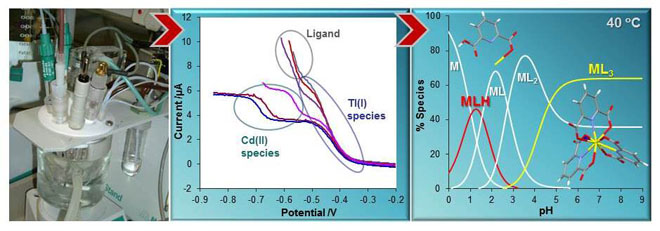
It is known that the value of a stability constant is dependent on the solution conditions under which it was determined. However, sometimes we need to be reminded that additional species could also form under different conditions. The work in the featured article clearly highlights how data obtained between pH 1-2 showed the formation of the unreported MLH species and data obtained at 40 °C revealed the formation of the ML3 species not detected at 25 °C. It is thus not necessarily vastly different conditions that could lead to the formation of other species not detected when working under the more conforming regime.
Working under more extreme conditions poses greater experimental and theoretical challenges, but could produce data more relevant to the application. Developing methodologies to study complex formation under more acidic conditions has opened the door to the study of metal ions that undergo hydrolysis at very low pH, such as Bi(III). There is clearly a gap in the literature on Bi(III) coordination chemistry due a number of difficulties faced when studying this metal ion.
Additionally, it appears useful to incorporate information pertaining to complexes from other sources and use these as cues to gain a better overall understanding into speciation. This was illustrated by linking information about crystal structures of metal ion complexes, with particular emphasis on the conditions under which these crystals were grown, to the solution state species.


Figure legend: Direct current polarography was used to identify the metal-ligand complexes that predominated at specified pH values in solution which were then compared to the structures of crystals grown under controlled and comparable conditions.
Journal Reference
The Journal of Chemical Thermodynamics, Volume 96, May 2016, Pages 67–73.
Vanessa L. Vieira, Caren Billing,
Molecular Sciences Institute, School of Chemistry, University of the Witwatersrand, P.O. WITS, Johannesburg 2050, South Africa
Abstract
The Cd(II)-dipicolinic acid (pyridine-2,6-dicarboxylic acid) system was studied by polarography in the temperature range (298 to 313) K and ionic strength of (0.25 to 0.5) mol · dm−3 (H,K)NO3. Apart from detecting the already reported ML and ML2 complexes and reporting the log β values at T = (298, 305 and 313) K, an ML3 complex was also found to form at 40 °C giving a log β value of 13.5 ± 0.1. ML3 was not present to a significant extent at lower temperatures indicating an endothermic formation process. This finding is supported by the ML3 structure being reported for crystals grown atT = 313 K. The system was also studied from pH 1 using protocols developed employing Tl(I) as an internal reference. The MLH species was found in the low pH range with log β values of 8.4 ± 0.2, 8.2 ± 0.2 and 8.0 ± 0.1 found at T = (298, 305 and 313) K, respectively.
Go To The Journal of Chemical Thermodynamics