 Advances in Engineering Advances in Engineering features breaking research judged by Advances in Engineering advisory team to be of key importance in the Engineering field. Papers are selected from over 10,000 published each week from most peer reviewed journals.

Significance
The increasing stringent mitigation rules on environmental preservation and the use of fossil fuels have inspired the development of alternative sources of energy. In particular, solar energy has attracted significant research attention. However, the high cost of silicon-based solar cell technology as compared to conventional power generation methods have derailed its development and deployment as an alternative energy source. In an attempt to address the high costs, solar cells based on dye-sensitization of mesoporous titanium oxide films were introduced to offer moderate efficiency at relatively low cost. To this end, significant efforts today have been devoted to improving the performance efficiency of dye-sensitized solar cells.
Generally, unwanted processes such as dye aggregation, semiconductor surface protonation, and charge recombination are the major barriers in achieving efficient dye-sensitized solar cells and should be avoided. This requires the development of new materials of dye-sensitized solar cells with knowledge regarding the interaction between them which will help in unleashing their valuable functionality.
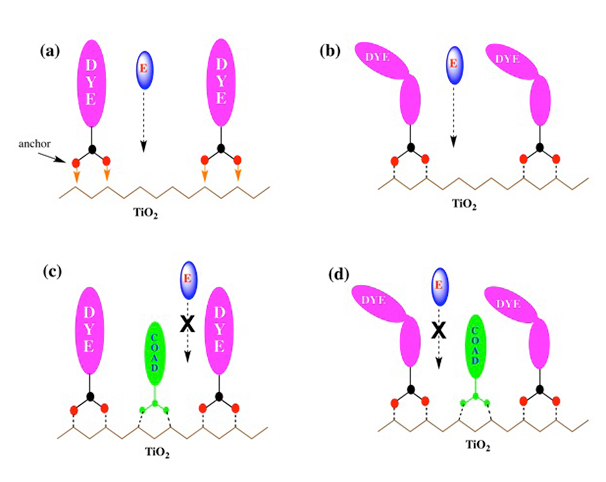
In a recent paper published in Physical Chemistry Chemical Physics, Dr. Luciano da Silva from Centro de Investigacion Quimica Aplicada (CIQA) together with Professor Harold Freeman from North Carolina State University investigated the effects of co-adsorbents in dye-sensitized solar cell systems. Taking into consideration that a combination of co-adsorbent and dye provides a good insulating barrier, its potential application in co-sensitized solar cells is a promising solution to enhancing the solar cell performance.
The authors started their research work by synthesizing and characterizing three compounds as co-adsorbents for dye-sensitized solar cells. The phenyltetrazole system-based compounds included 5-(4-hydroxyphenyl) tetrazole (LTz-1), 5-(4-methoxyphenyl) tetrazole (LTz-2) and 5-(4-hexyloxyphenyl) tetrazole (LTz-3). Secondly, they investigated the effects of hydrophobic chain length of the co-adsorbents with HD-2 dye attached to titanium oxide thin films as well as the effects of the anchoring group on the properties of the dye-sensitized solar cells and compared the results to that of a deoxycholic acid prototype.
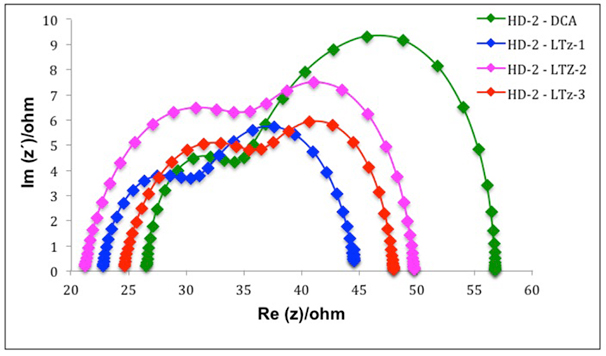
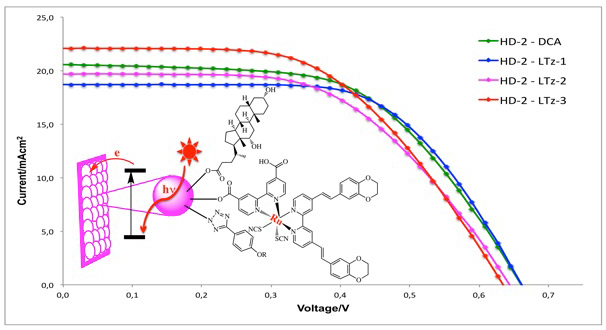
The tetrazole functional group proved to be effective and suitable for alternative co-adsorbent moiety for organic photosensitizers. The photo-injection efficiency in dye-sensitized solar cells was improved by two effects that could be distinguished based on the structural characteristics of the evaluated co-adsorbents. The same effects also allowed efficient transfer of charges from the dye to the phenyltetrazole system through stacking interactions. The maximum and minimum charge transfer resistance of the dyne/ titanium oxide was observed in LTz-2 and LTz-1 respectively. On the other hand, the Voc readings for the dye HD-2 with co-adsorbents deoxycholic acid, LTz-1, LTz-2 and LTz-3 were recorded as 0.66V, 0.70V, 0.68V, and 0.67 V respectively.
Unlike co-adsorbent deoxycholic acid that reported a mean solar-to-power conversion efficiency of 7.76, the three developed devices recorded relatively higher conversion efficiencies under the same experimental conditions. For LTz-3 co-adsorbents, the results were attributed to repellent effects of long alkyl chain while for LTz-1 and LTz-2 co-adsorbents, the electron injection efficiency was improved by the compact layer formed.
Based on the results by Dr. da Silva and Professor Harold Freeman, the efficiency of the dye-sensitized solar cells is strongly dependent on the electron injection process on titanium oxide. Therefore, the study provides a promising approach for improving the performance of the dye-sensitized solar cells.


Reference
da Silva, L., & Freeman, H. (2019). Variation in hydrophobic chain length of co-adsorbents to improve dye-sensitized solar cell performance. Physical Chemistry Chemical Physics, 21(30), 16771-16778.