Advances in Engineering Advances in Engineering features breaking research judged by Advances in Engineering advisory team to be of key importance in the Engineering field. Papers are selected from over 10,000 published each week from most peer reviewed journals.

Significance
Timber-based materials have been widely used in various construction activities for centuries. Timber is readily available, cost-effective and does not require complex processing techniques. Among the known timber products, glued laminated timber (GLT), also known as glulam, has attracted attention owing to its remarkable properties. This structurally engineered wood product comprises constituent dimensional lumber layers bonded together by durable and moisture resistant structural adhesives. As a result, this type of wood product is highly durable, geometrically variable and can generate unique shapes.
Nevertheless, low shear strength and tensional strength perpendicular to the grain, often induce cracks parallel to the grain. Additionally, changes in climate conditions may lead to unbalanced shrinkage in GLT members, thereby leading to cracks. These limitations have been the main barrier to the widespread application of GLTs. Currently, the most promising approach for counteracting these low-strength properties is by using local reinforcements aligned in the direction perpendicular to the grain of the wood component. This includes using fully threaded screws or threaded rods. These reinforcements are, however, activated only in cracked timber members and can induce more cracks because they restrict the free shrinkage of the timber.
Previous findings revealed a plane reinforcement that can generally increase robustness due it its remarkable performance over the entire beam length. Consequently, beams having plane reinforcements offer high flexibility for interior applications and involve cross-sections that can be arranged in the existing beam structures without further structural analysis. Inspired by these findings, Professor Philipp Dietsch from the Karlsruhe Institute of Technology together with Markus Lechner and Professor Stefan Winter from the Technical University of Munich reported the further development of plane reinforced GLT. Their research is currently published in the journal, Construction and Building Materials.
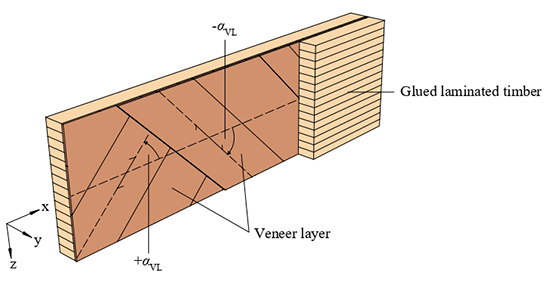
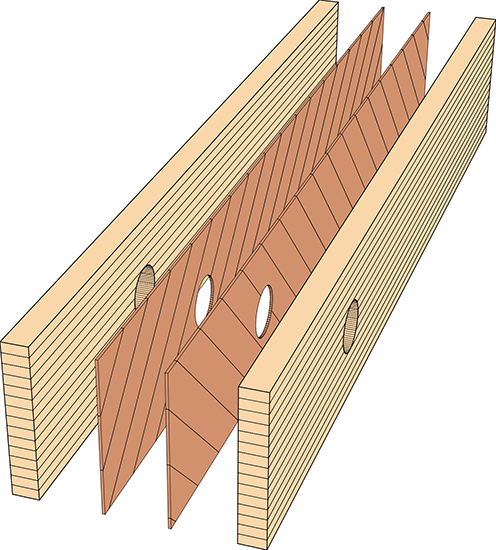
In their approach, a novel veneer-reinforced timber (VRT) product was developed by vertically inserting veneer from beech between two glulam cross-sections. The inserted veneers acted as the reinforcement for shear and tension stresses perpendicular to the grain. The veneer layers were arranged between the glulam components at angles of 0°, 45° and 90° to homogenize the stiffness and anisotropic strength properties of the glulam. Finally, the efficiency and load-bearing capacity of the veneer-reinforced timber was investigated through numerical simulations and experimental tests.
The researchers reported a considerable improvement in the stiffness and strength properties as well as load-bearing capacities of the newly developed veneer-reinforced timber. The load-bearing capacities around connections, holes or notches could be doubled, respectively tripled. The average shear strength and shear modulus were increased by 67% and 50%, respectively, and were comparable to those of common hardwood products. Compared with veneers oriented at 90°, those inclined veneers caused fewer cracks due to the reduced restrained shrinkage of the glulam component.
Two recommendations were provided. The restraining effects of the veneer plates can be mitigated by reducing their inclination angles, that will result in fewer cracks. Another general requirement which also applied to the GLT components of the VRT is that the wood moisture content during the production of the GLT components should correspond to the expected equilibrium moisture content during the operation of the building.
In summary, the authors reported the successful development of a new veneer-reinforced timber with improved properties and demonstrated its performance in different cases. From the results, VRT emerged as an effective alternative for reinforcing different timber elements, especially those with geometries where stresses are perpendicular to the grain direction. In a statement to Advances in Engineering, Professor Philipp Dietsch explained that the novel reinforced hybrid timber product would contribute to the sustainability of the construction industry by supporting the growing efforts to increase the use of wood in construction while at the same time increasing material efficiency of structural timber products.




Reference
Lechner, M., Dietsch, P., & Winter, S. (2021). Veneer-reinforced timber – Numerical and experimental studies on a novel hybrid timber product. Construction and Building Materials, 298, 123880.