Advances in Engineering Advances in Engineering features breaking research judged by Advances in Engineering advisory team to be of key importance in the Engineering field. Papers are selected from over 10,000 published each week from most peer reviewed journals.

Significance
A good comprehension of the fracture mechanics is crucial for determining reasons for failure in metals. The most common metal failures are either brittle or ductile fractures depending on the extent to which the metal can undergo large plastic deformation before fracture. For ductile metals, the tensile test for the fracture process is grouped into either uniform deformation or local deformation. During local deformation, voids nucleate and grow due to increase in the stress tri-axiality and simultaneous increase in the dislocation density. Additionally, when both strain and void volume fraction reach the critical values ductile fracture occurs. The void nucleation mechanisms are classified into two: homogeneous and heterogeneous nucleation. For the former to occur there must be an increase in the dislocation density and vacancy migration where the latter is affected by material defects, such as the presence of inclusions, precipitates among other discontinuous structures.
Intense works have been undertaken regarding heterogeneous void nucleation. Such studies have helped reveal that voids nucleate at grain boundaries between the varying phases. More so, similar works have suggested that void nucleation depends on stress triaxiality and the microstructure, including the grain boundaries and particles. However, there exists no published tentative studies of the void nucleation behavior in metal specimens that contain neither particles nor grain boundaries so far, despite the crucial role that void nucleation plays in determining local deformation of ductile materials.
Professor Osamu Furukimi and colleagues at Kyushu University in Japan examined the void nucleation behavior of single-crystal iron in tensile stress. Their main aim was to explore the mechanism of void nucleation during tensile deformation for single-crystal iron specimens of small size containing no microstructural defects, such as grain boundaries or precipitated particles. Their work is now published in the research journal, Materials Science & Engineering A.
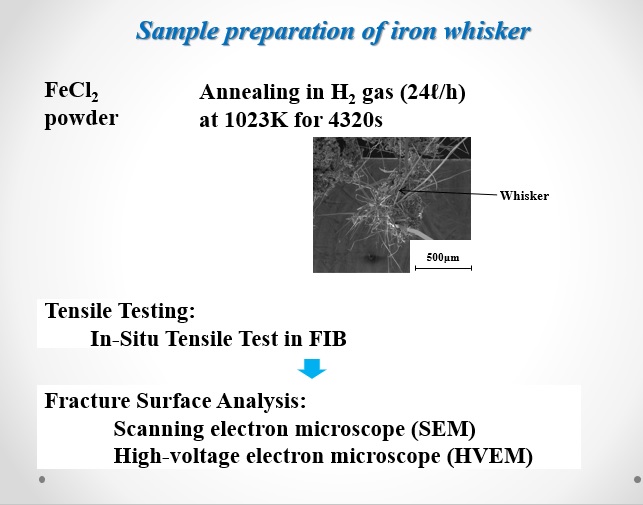
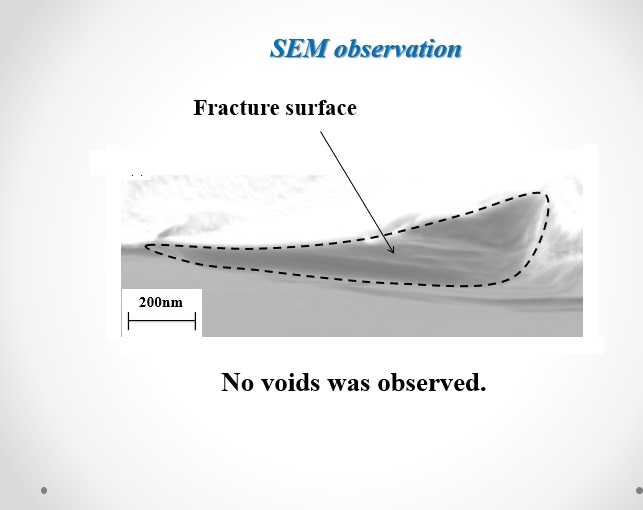
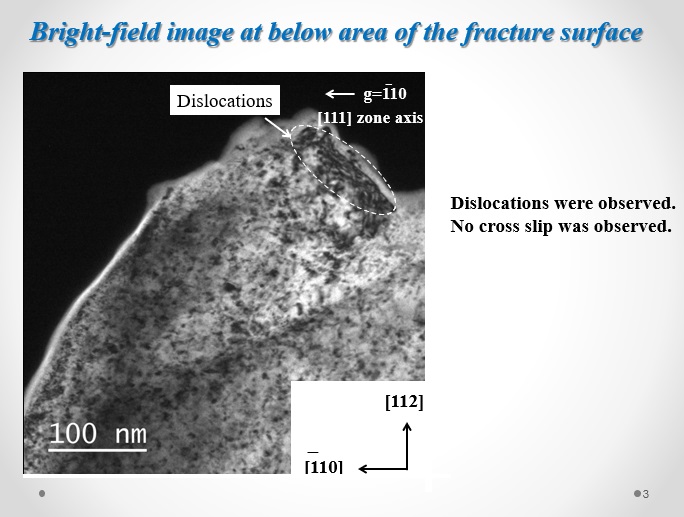
The researchers initiated their experiment by selecting two micrometer-size single crystals having a different type of slip extracted from electro-deposited pure iron for use to investigate the fracture mechanics during tensile deformation. The team then applied high voltage electron microscopy imagery and scanning electron microscopy technique to verify the existence of only one single slip system in the smaller specimen while still checking out for voids. A similar procedure was then carried out for the larger specimen.
The research team was able to observe that the smaller specimen exhibited straight slip patterns while for the larger specimens, a number of shear bands and wavy slip patterns were observed. The researchers also noticed the nucleation behavior of voids in single-crystal iron specimens. It was observed that voids with diameters of 50–100 nm were present along the slip band in the larger specimen.
The Osamu Furukimi et al study has presented novel insight and fundamental information on void nucleation during tensile testing for single-crystal iron specimens of smaller sizes with no precipitated particles or grain boundaries. The critical information that has been brought forward is that upon deformation, voids nucleate even in single-crystal materials, which naturally have no precipitates or grain. Furthermore, since no slip took place in the smaller sample, it can therefore be concluded that multiple slips are a necessary criterion for void nucleation in single-crystal iron.







Reference
Osamu Furukimi, Chatcharit Kiattisaksri, Yuji Takeda, Masatoshi Aramaki, Satoshi Oue, Shinji Munetoh, Masaki Tanaka. Void nucleation behavior of single-crystal high-purity iron specimens subjected to tensile deformation. Materials Science & Engineering A volume 701 (2017) pages 221–225.
Go To Materials Science & Engineering