Advances in Engineering Advances in Engineering features breaking research judged by Advances in Engineering advisory team to be of key importance in the Engineering field. Papers are selected from over 10,000 published each week from most peer reviewed journals.

Significance
The therapeutic window of a certain drug reflects the concentration range that provides efficacy without toxicity. Narrow therapeutic index (NTI) drugs have a narrow therapeutic window, hence doses must be titrated carefully and therapeutic monitoring is usually required. Examples of NTI-drugs: aminoglycosides, ciclosporin, carbamazepine, digoxin, digitoxin, flecainide, lithium, phenytoin, phenobarbital, rifampicin, theophylline and warfarin.
In the case of Warfarin which is one of the most commonly prescribed anticoagulant agents, it is mainly prescribed as a low dose tablet, therefore ensuring content uniformity standards is of great significance. This necessitates effective control of the NTI formulations because a small variation in the tablet formulations may result in ineffective or dangerous therapeutic consequences. As an anticoagulant, warfarin prevents blood clots in blood vessels and is useful in treating different serious and life-threatening conditions like stroke and cardiovascular diseases. In particular, warfarin sodium 2-propanol solvate (WARC) tablets, a low-dose drug products made from either amorphous or crystalline forms of warfarin sodium, have been widely preferred for treating such conditions.
The therapeutic and clinical outcome of WARC tablets has raised many concerns. Warfarin associated hemorrhage is one of the main causes of deaths amongst anticoagulant patients. Moreover, the US Food and Drug Administration removed several warfarin sodium products from the market, a move that can be attributed to poor dose performance, quality issues, as well as low dose formulations and NTI challenges. In addition to bioavailability issues, previous research has reported that multiple stages involved in the manufacturing of WARC can potentially introduce undesirable transformations that may influence the drug outcomes. Therefore, it is extremely important to ensure WARC solid-state integrity from manufacturing to patient administration.
Several techniques have been proposed to evaluate the transformation of the WARC solid-state. Nevertheless, the available methods do not provide a comprehensive characterization and understanding of the transformation of the WARC lattice structure responsible for product failure. To address this challenge, researchers from Long Island University in New York: Dr. Harsh S. Shah, Dr. Kaushalendra Chaturvedi, Dr. Rutesh Dave, Dr. Simon Bates, Dr. Rahul Haware, and Professor Kenneth Morris studied the solid form changes of the WARC considering the environmental conditions and possible manufacturing stress. Their main aim was to predict the WARC structural integrity at different storage conditions by monitoring and quantifying the real-time changes in their crystal lattice. The original research article appears in the journal, Crystal Growth and Design.
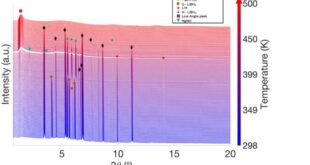
In their approach, thermal stress was studied using variable temperature powder X-ray diffraction (PXRD), allowing for real-time monitoring of WARC solid-state transformations. WARC was exposed to moisture and thermal stresses at different time durations to achieve the solid-state changes. Also, dynamic sorption-desorption isotherms were used to evaluate the sorption behavior of various WARC forms. Lastly, quantitative predictive models were developed to evaluate the impact of various parameters on the WARC structural integrity.
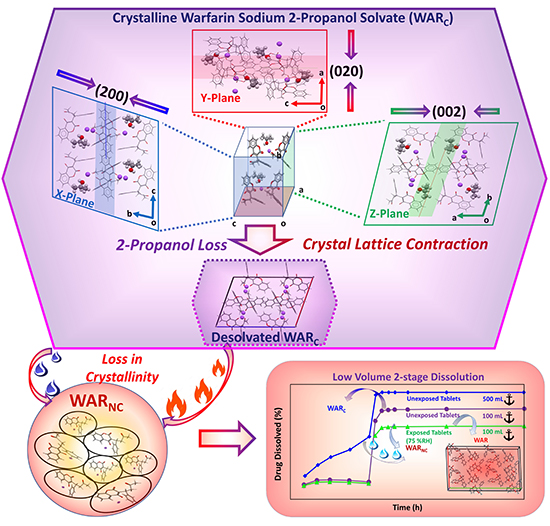
Results show that after prolonged exposure to high-temperature stress, WARC transformed into desolvated WARC (WARDES) and non-crystalline (WARNC) forms. This was attributed to the 2-propanol (IPA) loss from the crystal lattice channel at high temperatures. However, at high relative humidity conditions, it directly transformed into WARNC due to increased WARC affinity for water molecules. Additionally, the solid-state transformations of the WARC were attributed to the interactions amongst the exposure time, temperature and humidity parameters. Unlike the unexposed tablets, stressed WARC tablets exhibited impaired dissolution profiles, which could potentially pose a serious WARC therapy failure, including clotting and internal bleeding.
In summary, this study is the first ever to report the crystal structure of WARC desolvated form. The predictive models enabled quantifying the IPA content, temperature, exposure time, WARC crystallinity and water content as a function of %RH. The results demonstrated the importance of achieving a good balance between the temperature, humidity and exposure time in maintaining the structural integrity of WARC at molecular level. The study provided a comprehensive understanding that may facilitate the effective design of quality dosage forms and quality control of warfarin tablets during manufacturing. In a statement to Advances in Engineering, Dr. Harsh S. Shah explained the findings will advance the development of more effective and efficient NTI WARC formulations as well as similar drug products developed in future.



References
Shah, H.S., Chaturvedi, K., Dave, R., Bates, S., Haware, R., & Morris, K. (2020). New Insights on Warfarin Sodium 2-Propanol Solvate Solid-State Changes Using a Multivariate Approach. Crystal Growth & Design, 20(11), 7328-7340.
Shah, H. S., Chaturvedi, K., Dave, R. H., & Morris, K. R. (2021). Molecular Insights into Warfarin Sodium 2-Propanol Solvate Solid Form Changes and Disproportionation Using a Low Volume Two-Stage Dissolution Approach. Molecular Pharmaceutics, 18(4), 1779-1791.
Shah, H. S., Chaturvedi, K., Hamad, M., Bates, S., Hussain, A., & Morris, K. (2019). New insights on solid-state changes in the levothyroxine sodium pentahydrate during dehydration and its relationship to chemical instability. AAPS PharmSciTech, 20(1), 1-10.