Advances in Engineering Advances in Engineering features breaking research judged by Advances in Engineering advisory team to be of key importance in the Engineering field. Papers are selected from over 10,000 published each week from most peer reviewed journals.

Significance
During design of structural elements, the need to improve efficiency of the load bearing structure often arises; under such circumstances, the designer has two options at their disposal: to either change the material, or change the geometry. Trusses are a class of structural elements usually formed of multiple individual elements connected at joints that are able to surpass the efficiency limits of simple sections. Advances in material engineering has borne composite materials, such as: fiber reinforced concrete and concrete-filled fiber-reinforced polymers. As such, advanced composite materials are an increasingly common choice for improving structural efficiency. For trusses, the loading within its members is dominant along their length. Consequently, forming these members with fiber reinforced composites would seem intuitive. In fact, it would not only result in a combination of highly efficient geometry and material, but also maximize material properties in the primary stress direction by aligning fibers with the members length. Regardless, the use of composite trusses to date has been limited due to increased complexities in truss manufacturing as a result of the numerous members to be jointed.
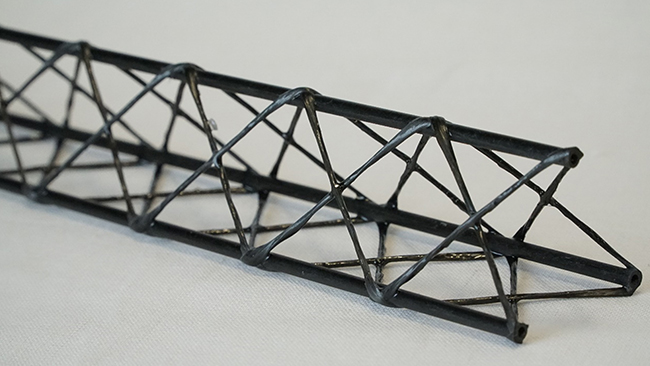
To this end, studies have been undertaken aimed at developing composite trusses using novel manufacturing techniques that reduce or remove the need for bonding multiple members. One notable publication reported on the Wrapped Tow Reinforced (WrapToR) truss concept that basically uses an adaptation of the filament winding process to produce composite truss beams. Unfortunately, this novel technique suffers from several shortfalls that ought to be resolved. On this account, researchers from the Bristol Composites Institute in the Department of Aerospace Engineering at University of Bristol in England: Christopher Hunt (PhD candidate), Professor Michael Wisnom and Dr. Benjamin Woods developed a novel configuration to increase the buckling resistance of the shear web members, ultimately translating to a more efficient manufacturing process. Their work is currently published in the research journal, Composite Structures.
Foremost, the novel approach, previously untested, involved twisting of the fiber tow during winding to produce shear web members with circular cross-sections. Specifically, the researchers designed, detailed and build a computer numerical controlled (CNC) truss winding machine that was used to fabricate trusses. Afterwards, the fabricated trusses were tested purposefully to failure so as to investigate the effects of tow twisting on structural performance. Finally, a comparison to commercially available composite tubes was conducted.
The authors reported that tow twisting improved the consistency of the cross-section shape and increased minimum second moment of area. However, analysis carried out using the direct stiffness method was seen to overpredict truss stiffness suggesting invalidity in the assumptions used by the method. Nonetheless, experimental comparison of WrapToR trusses with conventional composite pultruded unidirectional tubes confirmed that at the length scales tested, the truss configuration provided large improvements in structural efficiency.
In summary, the University of Bristol study investigated the effectiveness of a simple design technique for increasing the structural efficiency of WrapToR composite structures. Generally, their new technique involved twisting of the carbon fiber tow during the winding process to alter the shape of the shear members for improved buckling resistance.



Reference
Christopher J. Hunt, Michael R. Wisnom, Benjamin K.S. Woods. WrapToR composite truss structures: Improved process and structural efficiency. Composite Structures, volume 230 (2019) 111467.