Advances in Engineering Advances in Engineering features breaking research judged by Advances in Engineering advisory team to be of key importance in the Engineering field. Papers are selected from over 10,000 published each week from most peer reviewed journals.

Significance
Due to the reduced component weight and increased fuel efficiency, TiAl based alloys show great potential in fields such as the aerospace and automobile industries. Investment casting is the most cost-effective method of producing near-net-shape TiAl components like low pressure turbine (LPT) blades, and ceramic shell mold production is one of the key steps in the casting route. The face coat of the mold is required to be highly inert and according to the massive research on face coat materials, yttria is the best option. However, loose yttria particles may be washed off the mold into the molten metal and become yttria inclusions in the cast products.
In this work, two typical TiAl based alloys, Ti-45Al-2Mn-2Nb (at%) + 0.08vol% TiB2 (45XD) and Ti-46Al-2Nb-2Cr-0.15B (at%) (4622) were produced by investment casting using yttria face-coated molds. The room temperature tensile properties of the inclusion containing alloys were investigated; the effects of yttria inclusion were discussed.
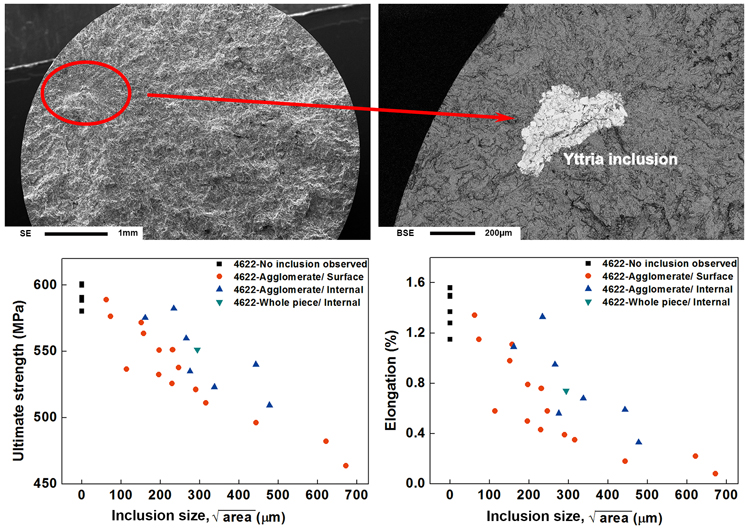
Yttria inclusions tend to act as crack initiation sites and are detrimental to the room temperature tensile properties of TiAl, especially ultimate strength and plastic strain. The effects of yttria inclusions are mainly determined by inclusion location and size. Those located at the sample surface or with larger sizes are more detrimental as they cause a higher stress intensity. The room temperature tensile properties of TiAl can be estimated with inclusion size and location determined by X-ray tomography. The critical inclusion size to cause tensile failure is close to that of the grain size.






Reference
Bochao Lin 1,2, Renci Liu 1, Qing Jia 1, Yuyou Cui 1, Paul A. Withey 3,4, Rui Yang 1. Effect of yttria inclusion on room temperature tensile properties of investment cast TiAl. Materials Science and Engineering: A. Volume 712, 2018, Pages 73-79.
1. Institute of Metal Research, Chinese Academy of Sciences, 72 Wenhua Road, Shenyang 110016, China.
2. University of Chinese Academy of Sciences, 19(A) Yuquan Road, Beijing, China.
3. Rolls-Royce plc, Derby, DE24 8BJ, UK.
4. School of Metallurgy and Materials, Univerisity of Birmingham, Edgbaston, Birmingham B15 2TT, UK.
Abstract
Yttria is the best face coat material in the shell mold for the investment casting of γ-TiAl alloys. However, yttria inclusions may occur in the cast products and there is a lack of knowledge about the influence of yttria inclusions on the mechanical properties of TiAl. In the present study, the effect of yttria inclusions on room temperature tensile properties of two investment cast TiAl alloys, Ti-45Al-2Mn-2Nb (at.%) + 0.08 vol.% TiB2 and Ti-46 Al-2 Nb-2Cr-0.15B (at.%), were studied. The results show that tensile failure tends to initiate from yttria inclusions, resulting in reduced elongation and ultimate strength. Yttria inclusions differ in location (surface / internal), size, and morphology (agglomerate / whole piece), those with larger sizes or located at the sample surface being more harmful. The tensile properties of inclusion containing TiAl parts can be estimated using the size and location determined by X-ray inspection. The critical size at which inclusions become detrimental to the mechanical properties of TiAl was discussed.