Advances in Engineering Advances in Engineering features breaking research judged by Advances in Engineering advisory team to be of key importance in the Engineering field. Papers are selected from over 10,000 published each week from most peer reviewed journals.

Significance Statement
Fossil fuels, coal in particular, play a crucial role in promoting the development of global societies and economics, providing humans with organic chemical resource and energy. Coal is a non-renewable resource and the fast exploitation and consumption is leading to its depletion. The negative effects of the excessive use of coal on the environment are evident and the limited coal reserves on earth, especially the high rank coals, inhibit sustainable utilization of the coal resource in the long run. Consequently, international attentions have been focused on realizing a high efficiency and clean utilization of coal while paying special emphases on exploring value-added utilization approaches of the low rank coals. Of great importance is how to improve the utilization efficiency of the low rank coals or their components and realize their hierarchical utilization is an important issue facing the human society.
Researchers at Inner Mongolia University of Technology led by professor Quansheng Liu and Dr. Huacong Zhou proposed a study exploring the value added utilization approaches of low rank coals or their components and, in parallel, promoting the conversion of sustainable resources such as biomass, into useful chemicals for human exploitation. They aimed at employing the abundant humic acids and transition metal zirconium to prepare a novel zirconium-based hydrogen transfer catalyst. Their work is now published in the peer-reviewed journal, Fuel.
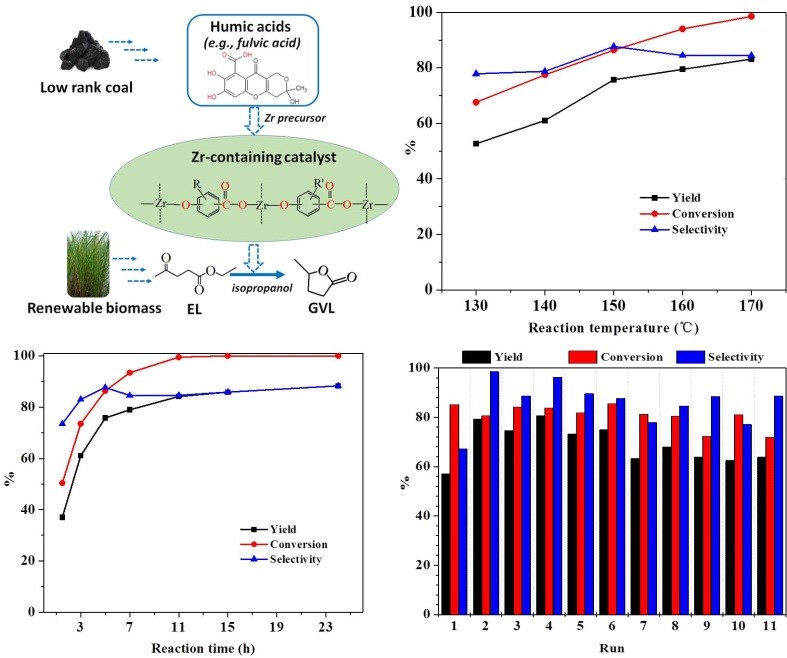
The researchers began by preparing Meerwein-Ponndorf-Verley reaction-inspired catalyst using the natural humic acids and transition metal zirconium salts as the main material, using a new strategy they had developed. They then applied the prepared catalyst into the conversion of biomass-derived ethyl levulinate into gamma-valerolactone through hydrogen transfer reaction. During this conversion process, both the preparation conditions and reaction parameters of the catalysts were investigated. The catalyst was then characterized using various techniques.
The authors observed that the zirconium-based catalyst was highly efficient in the conversion of ethyl levulinate into gamma-valerolactone. It was also noted that under optimized conditions, the ethyl levulinate could be completely converted and the gamma-valerolactone yield could reach up to 88%. In simple terms, the novel catalyst was seen to possess high activity and excellent stability for the intended conversion.
In summary a novel zirconium-humic acids catalyst has been developed which possess several advantages including: using the abundant and low-cost humic acids as a raw material, simple preparation procedure and excellent stable performances. The catalyst can also be used at least eleven times by batch experiments without notable changes in both activity and structures thereby indicating excellent stability. All in all, this is a novel route that has not been used anywhere before, and the proposed route is meaningful for the utilization of both low rank coals and biomass resources.

Reference
Zhenhuan Xiao, Huacong Zhou, Jianmin Hao, Hailong Hong, Yinmin Song, Runxia He, Keduan Zhi, Quansheng Liu. A novel and highly efficient Zr-containing catalyst based on humic acids for the conversion of biomass-derived ethyl levulinate into gamma-valerolactone. Fuel, volume 193 (2017) pages 322–330.
Go To Fuel