Advances in Engineering Advances in Engineering features breaking research judged by Advances in Engineering advisory team to be of key importance in the Engineering field. Papers are selected from over 10,000 published each week from most peer reviewed journals.

Construction and Building Materials, Volume 40, March 2013, Pages 473-480.
E.R. Silva, J.F.J. Coelho, J.C. Bordado.
Instituto Superior Técnico, Chemical Engineering Department, IBB, Universidade Técnica de Lisboa, Av. Rovisco Pais, 1049-001 Lisboa, Portugal and
Universidade de Coimbra, Chemical Engineering Department, Rua Sílvio Lima, 3030-790 Coimbra, Portugal.
Abstract
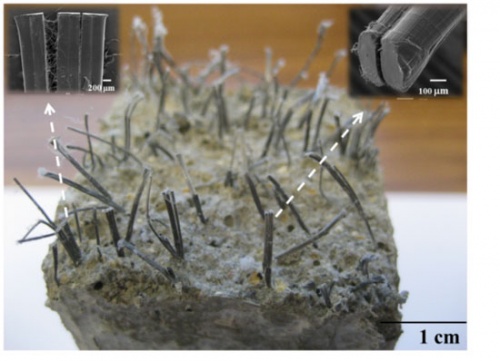
Cement-based materials have long been recognized as desirable products for construction purposes, particularly for those structures subjected to high loadings or pressures and where its weight is not a critical factor (e.g. building, pavements). However, they revealed relative weakness as a structural material, due to their intrinsic brittle properties, thus requiring in a relative short lifetime for costly maintenance. Several strategies have been pursued in order to mitigate such fragility. Among these, fibre-reinforced cements/concretes (FRC) have been focus of particular attention, mainly due to fibres’ crack bridging effect. Recently, an increasing interest on synthetic fibres has emerged, as a result of their greater chemical and corrosion resistance, better plastic shrinkage and relative low density. Efforts have been done in order to provide synthetic fibre systems able to promote a reinforcing effect, such as physical/chemical fibres properties modifications or fibre volume increasing. But, some technical limitations are still not overcome. It is reported that in order to strengthen the composites it is required to reach a critical fibre volume (Vf = 3%). Nonetheless, the current premix processes, suitable to prepare these systems, are only able to provide more than 2% of Vf in the cement matrix, mainly due to fibre balling. These limitations together with fibres cost, gives rise to a not satisfactory using of fibres as a reinforcing material. Our study aims to provide an insight into the mechanical reinforcing performance of newly hybrid-blended polypropylene/ polyethylene (PP/PE) fibres in mortar systems. The obtained PP/PE hybrid fibre reinforced mortar composites evidenced promising mechanical performances. Enhances up to 40 % were achieved on compressive and flexural strengths for composites reinforced with a fibre volume as high as 2.9 % (considerably higher than the standard fibre volume (2%) of premix processes). Morphological observations of composites evidenced a strong fibre/cement interface interactions, which were attributed to a combined effect of different factors, associated to the hybrid fibres’ peculiar properties, such as: unusual high cross-section area (0.52 mm2), fibres’ surface rugosity, lower aspect ratio (7.35), higher FIER (1.79), and their self-fibrillation ability. All these factors promoted a better fibre/cement anchoring, leading to a more effective reinforcing action, and thus to higher post-cracking arresting effect of composites when subject to mechanical stresses. This research study can make an important contribution for boost confidence in the new generation of hybrid fibres reinforced cement-based composites and their potential enhancement as a construction material.