Advances in Engineering Advances in Engineering features breaking research judged by Advances in Engineering advisory team to be of key importance in the Engineering field. Papers are selected from over 10,000 published each week from most peer reviewed journals.

International Journal of Multiphase Flow, Volume 50, April 2013, Pages 1-15.
Michael Conrath, Yulia Smiyukha, Eckart Fuhrmann, Michael Dreyer.
Center of Applied Space Technology and Microgravity (ZARM), University of Bremen, Am Fallturm 01, 28359 Bremen, Germany.
Abstract
We consider an assembly of two parallel porous screens suspended in a tube at a distance L. The screens are connected by wicking aids. If one screen is brought into contact with a wetting liquid, the other screen will be wetted as well enclosing gas in between. Due to surface tension in the screen pores, the gas can only be removed from the chamber when the pressure difference across one screen exceeds the bubble point. With such a double porous screen element it is therefore possible to block liquid flow using trapped gas as plug. We present a model approach, experiments and numerical calculations on the performance of such a screen element. The model is based on capillary transport in vertical and radial capillaries and allows to predict how fast the element will trap the gas to become operational. For the experiments, we have built such an element using Dutch Twilled weaves made of stainless steel. Placed in a vertical tube and initially dry, it is wetted from below or above and submitted to an increasing pressure difference until breakthrough occurs where the element fails. Corresponding numerical calculations elucidate what happens within the element when it fails. Our results confirm the concept of the double porous screen element and encourage its application as liquid management device.
Additional Information:
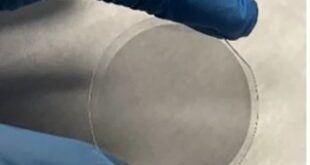
This work deals with a concept for a passive gas-liquid phase separation device. To block liquid flow through a tube, a plug of gas is captured between two hydrophilic screens. It is intended as one-way safety device to ensure pure gas flow or no flow. Key component to achieve this goal are thin and robust screens made of stainless steel wires. The picture shows the microscopic structure of the woven metal screens that are used (upper left), the mounted screen suspended on a ring (lower left) and a two-phase flow through such a screen seen from below and above (right).
Since the pores of the screen are wetted by the liquid, gas has to be pressurized to enter the pores. That is why gas is separated from a liquid flow and a gas bubble forms below the screen in the picture. Only beyond a critical pressurization, the so-called bubble point, gas can pass the screen pores. In the picture, the pressurization is caused by the cross-flow pressure loss across the screen, and tiny bubbles emerge from the upper side of the screen. The present work uses two of such screens that are connected by a wicking aid. As one screen gets wet, the other screen gets wet too due to the wicking aid. As a consequence, gas is captured between the two screens and blocks the pipe for any further flow.