Advances in Engineering Advances in Engineering features breaking research judged by Advances in Engineering advisory team to be of key importance in the Engineering field. Papers are selected from over 10,000 published each week from most peer reviewed journals.

The European Physical Journal B, 2013, 86:182.
Sulemana S. Abukari, Kofi W. Adu, Samuel Y. Mensah, Natalia G. Mensah, Kwadwo A. Dompreh,Anthony Twum, Musah Rabiu.
Department of Physics, Laser and Fibre Optics Centre, University of Cape Coast, Cape Coast, Ghana and
Department of Physics, The Pennsylvania State University, Altoona College, Altoona, Pennsylvania, 16601, USA and
Materials Research Institute, The Pennsylvania State University, University Park, Pennsylvania, 16802, USA and
National Centre for Mathematical Sciences, Ghana Atomic Energy commission, Kwabenya, Accra, Ghana and
Department of Mathematics, University of Cape Coast, Cape Coast, Ghana and
Department of Applied Physics, University for Development Studies, Navorongo, Ghana.
Abstract
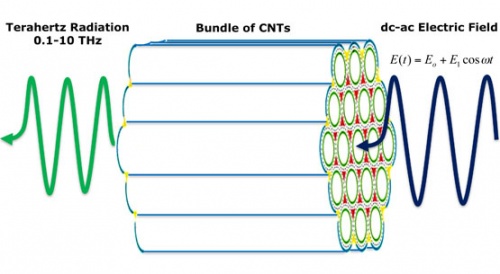
We investigate theoretically the feasibility of amplification of terahertz radiation in aligned achiral carbon nanotubes, a zigzag (12,0) and an armchair (10,10) in comparison with a superlattice using a combination of a constant direct current (dc) and a high-frequency alternate current (ac) electric fields. The electric current density expression is derived using the semiclassical Boltzmann transport equation with a constant relaxation time. The electric field is applied along the nanotube axis. Analysis of the current density versus electric field characteristics reveals a negative differential conductivity behavior at high frequency, as well as photon assisted peaks. The photon assisted peaks are about an order of magnitude higher in the carbon nanotubes compared to the superlattice. These strong phenomena in carbon nanotubes can be used to obtain domainless amplification of terahertz radiation at room temperature.
Additional Information:
In contrast to visible light, infrared, microwave and X-Ray, the unique properties and the nondestructive nature of terahertz (THz) radiation have made THz particularly attractive for myriads of applications ranging from biomedical imaging, national security, chemical and biological sensing, manufacturing and packaged goods inspection to remote sensing and spectroscopy. However, major challenges in developing the appropriate detectors and sources with meaningful power output continue to limit advances in the terahertz science and technology industry. Whereas, visible light, infrared and ultraviolet can be generated by direct blackbody sources, it is very difficult to generate useful power levels of THz radiation from a blackbody source. Additionally, unlike radio-frequency and microwave that can be generated by rapid switching of periodic oscillators, the switching is nearly impossible at the THz rate, and due to the plethora of the nonradiative mechanisms at the THz photon energies, the use of semiconductor methods at the THz frequencies are mostly impractical. Currently, the most popular techniques for THz generation are direct laser method (optically pump THz Laser and quantum cascade laser), laser enabled method (THz parametric oscillator, photomixing and time-domain systems) and electronic method (backward wave oscillator and direct multiplied sources). In this article, we investigated the use of carbon nanotubes stimulated axially with dc-ac-field for potential generation and amplification of THz radiation.