Advances in Engineering Advances in Engineering features breaking research judged by Advances in Engineering advisory team to be of key importance in the Engineering field. Papers are selected from over 10,000 published each week from most peer reviewed journals.

The International Journal of Advanced Manufacturing Technology, 2013, Volume 67, Issue 1-4, pp 771-784.
F. Mas, J. Ríos, J. L. Menéndez, A. Gómez.
AIRBUS Military, Av. García Morato s/n, 41011, Sevilla, Spain and
Universidad Politécnica de Madrid, José Gutiérrez Abascal 2, 28006, Madrid, Spain.
Abstract
The need to develop methods and software applications to support the design of assembly lines is academically and industrially acknowledged. This paper focuses on the conceptual design of aeronautical assembly lines. A model is proposed to represent the process to design an aerostructure assembly line at the conceptual design phase and the knowledge requirements to support such process. The conceptual design process is documented in an Integrated Definition for Function Modeling model and the knowledge model is documented in Unified Modeling Language. The model provides a starting point in the formalization of the assembly line conceptual design. The objective is to use such model for the development of a knowledge-based application prototype in an industrially used software system.
Additional Information
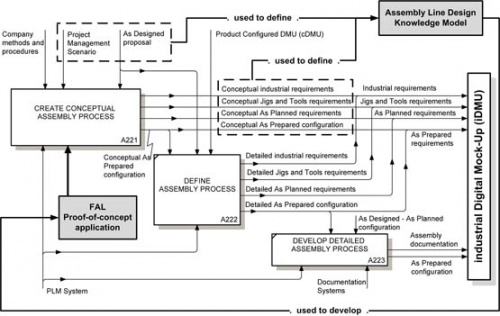
The design of an aircraft Final Assembly Line (FAL) is carried out in the aircraft industrialization activity. Such activity is subdivided into: Create Conceptual Assembly Process, Define Assembly Process, and Develop Detailed Assembly Process (see figure below). The Conceptual Assembly Process definition phase is characterized by depending heavily on the personnel experience and being time-consuming. Consequently, manufacturing engineers can only check a simplified set of cases to generate and submit early manufacturing processes and resource requirements. In order to enhance such process, a software development is proposed, to assist designers in the definition of scenarios and to generate FAL alternatives. Both the scenario and the generated FAL solution are part of the industrial Digital Mock-Up (iDMU). An iDMU comprises product, processes and resources information, both geometrical and technological. PLM systems are the tool to create, manage and support such industrial digital mock-up.
In order to demonstrate the industrial feasibility of the proposed solution, the development had to be carried out within the framework of a commercial PLM/CAX system used in the aircraft programs and comprising the iDMU concepts of: Product, Process and Resource (Catia/Delmia v5). This paper shows the industrial problem being addressed, the methodological approach based on using IDEF0 and UML as modelling techniques,, the conceptual design process model and its associated knowledge units, which are used in the development of a proof-of-concept application.
The main contribution is the aircraft assembly line conceptual design model. Literature review points out the interest of this area of work and the need for further contributions. The industrial practices from a particular company and a literature review were the inputs to the process model creation. Literature review shows no evidence of any other company’s process publicly available; therefore, the only external reference were the generic design processes proposed in the engineering design literature. In the definition of the model, by comparing with the generic design processes, particularities were aimed to be removed. The proposed model provides a starting point.
In a subsequent paper entitled: “Proposal for the conceptual design of aeronautical final assembly lines based on the industrial Digital Mock-Up concept”, in Proceedings of the 10th IFIF WG 5.1 Intl. Conference PLM 2013; further information can be found about the prototype application, dealing with the “As-Planned” and “As-Prepared” product structures, to prove the conceptual approach.