Advances in Engineering Advances in Engineering features breaking research judged by Advances in Engineering advisory team to be of key importance in the Engineering field. Papers are selected from over 10,000 published each week from most peer reviewed journals.

Applied Physics A, Volume 114, Issue 1, pp 215-221. (2014).
Koji Sugioka, Ya Cheng
Laser Technology Laboratory, RIKEN, Wako, Saitama, 351-0198, Japan and
State Key Laboratory of High Field Laser Physics, Shanghai Institute of Optics and Fine Mechanics, Chinese Academy of Sciences, No. 390 Qinghe Road, Jiading, Shanghai, 201800, China
Abstract
Femtosecond lasers have opened up new avenues in materials processing due to their unique characteristics of ultrashort pulse widths and extremely high peak intensities. One of the most important features of femtosecond laser processing is that a femtosecond laser beam can induce strong absorption in even transparent materials due to nonlinear multiphoton absorption. This makes it possible to directly create three-dimensional (3D) microfluidic structures in glass that are of great use for fabrication of biochips. For fabrication of the 3D microfluidic structures, two technical approaches are being attempted. One of them employs femtosecond laser-induced internal modification of glass followed by wet chemical etching using an acid solution (Femtosecond laser-assisted wet chemical etching), while the other one performs femtosecond laser 3D ablation of the glass in distilled water (liquid-assisted femtosecond laser drilling). This paper provides a review on these two techniques for fabrication of 3D micro and nanofluidic structures in glass based on our development and experimental results.
Additional Information:
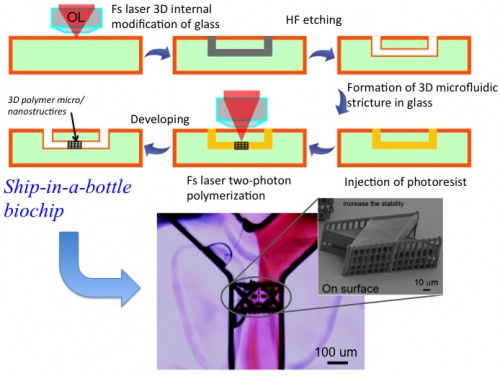
To further enhance the functionalities of biochips, a new method termed hybrid femtosecond laser microfabrication which consists of successive subtractive (femtosecond laser-assisted wet etching of glass) and additive (two-photon polymerization of polymer) 3D microprocessing was proposed. Novel biochips named “ship-in-a-bottle” biochips were then realized by integrating various 3D polymer micro/nanostructures into flexible 3D glass microfluidic channels. The ship-in-a-bottle biochips show high capabilities to provide simultaneous filtering and mixing with 87% efficiency in a shorter distance and on-chip synthesis of ZnO microflower particles.
More results in:
Laser Photonics Rev., 3, 386-400 (2010). DOI: 10.1002/lpor.200810074
Lab Chip 11, 2109-2115 (2011). DOI: 10.1039/C1LC20101H
Lab Chip 12, 746-749 (2012). DOI: 10.1039/C2LC21015K
Lab Chip 13, 1626-1631 (2013). DOI: 10.1039/C3LC41171K
Lab Chip 13, 4608-4616 (2013). DOI: 10.1039/C3LC50962A
Laser Photonics Rev., (2014). DOI 10.1002/lpor.201400005 (available online shortly).