Advances in Engineering Advances in Engineering features breaking research judged by Advances in Engineering advisory team to be of key importance in the Engineering field. Papers are selected from over 10,000 published each week from most peer reviewed journals.

European Polymer Journal, Volume 49, Issue 8, 2013, Pages 2052-2061.
D. Kołbuk, P. Sajkiewicz, K. Maniura-Weber, G. Fortunato.
Institute of Fundamental Technological Research, Polish Academy of Sciences, Pawinskiego 5B, 02-106 Warsaw, Poland and
Advanced Fibers, Empa, Swiss Federal Laboratories for Materials Testing and Research, Lerchenfeldstrasse 5, CH-9014 St. Gallen, Switzerland and
Materials-Biology Interactions, Empa, Swiss Federal Laboratories for Materials Testing and Research, Lerchenfeldstrasse 5, CH-9014 St. Gallen, Switzerland and
Protection and Physiology, Empa, Swiss Federal Laboratories for Materials Testing and Research, Lerchenfeldstrasse 5, CH-9014 St. Gallen, Switzerland.
Abstract
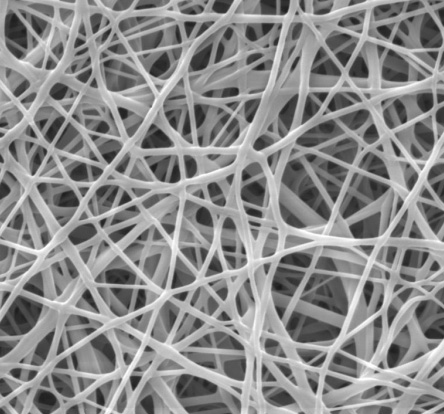
Blends of polycaprolactone (PCL) and gelatine (Ge), being effective materials for tissue engineering strategies, were electrospun at various conditions and polymer weight ratios. The morphology, the supermolecular structure as well as the mechanical properties of resulting submicron sized fibres have been analyzed in relation to electrospinning conditions and PCL/Ge weight ratio. Compared to pure PCL, Ge addition leads to large reduction of fibre diameter and finally to changes of fibre morphology. For parallelised fibres collected on a rotating drum, preferred molecular orientation of PCL crystals is found. With increasing Ge content a general reduction of molecular orientation is observed. In addition, there is peculiar dependence of polycaprolactone crystallinity on the content of Ge, showing maximum at low Ge concentration (20%) as determined by differential scanning calorimetry (DSC) and wide angle X-ray scattering (WAXS). Such a trend can be explained by hydrophobic interactions in the system containing PCL, gelatine and water, being additional driving forces for crystallization of nonpolar PCL molecules. The presence of water within investigated blend systems has been evidenced experimentally using thermal gravimetric analysis (TGA). Young’s modulus of nonwovens, as determined by uniaxial tensile testing, indicates the effect of additivity of the stiffness of both polymers as well as the influence of preferred molecular orientation. Additional experiments were performed using collagen (Col) as a biopolymeric alternative to Ge. WAXS results show evidently amorphous structure of Col within the blended fibres, indicating strong tendency for denaturation of collagen into gelatine under the influence of hexafluoroisopropanol as a solvent.