Advances in Engineering Advances in Engineering features breaking research judged by Advances in Engineering advisory team to be of key importance in the Engineering field. Papers are selected from over 10,000 published each week from most peer reviewed journals.

Geophysical Research Letters, Volume 40, Issue 10, pages 1952–1959, 2013.
Armin Kleinböhl, R. John Wilson, David Kass, John T. Schofield, Daniel J. McCleese.
Jet Propulsion Laboratory, California Institute of Technology, Pasadena, California, USA and
NOAA Geophysical Fluid Dynamics Laboratory, Princeton, New Jersey, USA.
Abstract
Atmospheric thermal tides are global oscillations in atmospheric fields that are subharmonics of a solar day. While atmospheric tides on Earth are mainly relevant in the upper atmosphere, on Mars, they dominate temperature variations and winds throughout the atmosphere. Observations and model simulations to date have suggested that the migrating diurnal tide is the predominant mode in the Martian atmosphere, and that the semidiurnal tide is only relevant in the tropical middle atmosphere during conditions of high dust loading. New comprehensive observations by the Mars Climate Sounder in a geometry that allows coverage of multiple local times show that the semidiurnal tide is a dominant response of the Martian atmosphere throughout the Martian year. The maximum semidiurnal amplitude of ~ 16 K is found at southern winter high latitudes, which makes it the largest tidal amplitude observed in the Martian middle atmosphere outside of dust storm conditions. The semidiurnal tide can be successfully modeled due to recent advances of Mars General Circulation Models (MGCMs) that include the radiatively active treatment of water ice clouds. Tidal forcing occurs through absorption of radiation by aerosols and points to the vertical structure of dust and clouds and their radiative effects as being essential for our understanding of the thermal structure and the general circulation of the Martian atmosphere. As with terrestrial GCMs trying to quantify mechanisms affecting climate, future Mars modeling efforts will require microphysical schemes to control aerosol distributions, and vertically and temporally resolved measurements of temperature and aerosols will be essential for their validation.
©2013. American Geophysical Union. All Rights Reserved.
Additional Information:
Atmospheric tides are the regular, repeating patterns of changes in pressure, temperature and winds in a planetary atmosphere that occur over the course of a solar day. In contrast to ocean tides, they are driven by variations in heating between day and night. On Earth, atmospheric tides are mostly relevant in the upper atmosphere. In the thin atmosphere of Mars, atmospheric tides are a dominant driver of short-term temperature changes and winds throughout the atmosphere.
Until recently is was believed that atmospheric tides were predominantly diurnal with one temperature minimum and maximum per Martian day. New observations reveal a global, semi-diurnal tide, which means there are two temperature maxima every day. During this twice-daily cycle, differences between maximum and minimum temperatures can be as high as 32 K. This is the largest tidal amplitude observed in the Martian middle atmosphere outside of a dust storm.
The observations were performed by the Mars Climate Sounder (MCS), a remote sensing instrument on board of NASA’s Mars Reconnaissance Orbiter (MRO). MCS is a mid- and far-infrared thermal emission radiometer. It has 8 IR and one visible/near-IR channel, each of which consists of a linear array of 21 thermopile detectors. MCS measures radiances in limb and nadir/on-planet geometry from which vertical profiles of atmospheric temperature, water vapor, dust and condensates can be retrieved in an altitude range from 0 to 80 km and with a vertical resolution of about 5 km. MCS has been taking measurements of the Martian surface and atmosphere since September 2006.
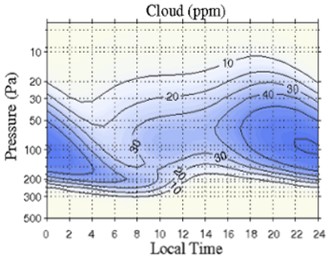
The semi-diurnal tide can be realistically modeled by Mars General Circulation Models (MGCMs) if the radiative effect of water ice clouds is taken into account. MGCMs are sophisticated computer models similar to the weather and climate models for Earth. The clouds identified as the main forcing of the semi-diurnal tide are located in the equatorial region between about 10 and 30 km altitude. The Figure shows a modeled cloud distribution over the course of a Martian day. The clouds absorb infrared radiation emitted from the surface during daytime, thereby providing the heating that forces the semi-diurnal tide. This shows that the radiative effect of water ice clouds will have to be considered in order to successfully model the Martian atmosphere.
(c) 2014 California Institute of Technology. Government sponsorship acknowledged.