Advances in Engineering Advances in Engineering features breaking research judged by Advances in Engineering advisory team to be of key importance in the Engineering field. Papers are selected from over 10,000 published each week from most peer reviewed journals.

Nature Nanotechnology 9, 384–390 (2014).
Virendra Singh, Thomas L. Bougher, Annie Weathers, Ye Cai, Kedong Bi, Michael T. Pettes, Sally A. McMenamin, Wei Lv, Daniel P. Resler, Todd R. Gattuso, David H. Altman, Kenneth H. Sandhage, Li Shi, Asegun Henry & Baratunde A. Cola.
George W. Woodruff School of Mechanical Engineering, Georgia Institute of Technology, 801 Ferst Drive, Atlanta, Georgia 30332, USA &
Department of Mechanical Engineering, University of Texas at Austin, 204 East Dean Keeton Street, Austin, Texas USA &
School of Materials Science and Engineering, Georgia Institute of Technology, 771 Ferst Drive, J. Erskine Love Building, Atlanta, Georgia , USA &
School of Mechanical Engineering, Southeast University, Nanjing, 211189, China &
Raytheon Company, Sudbury, Massachusetts 01776, USA.
Abstract
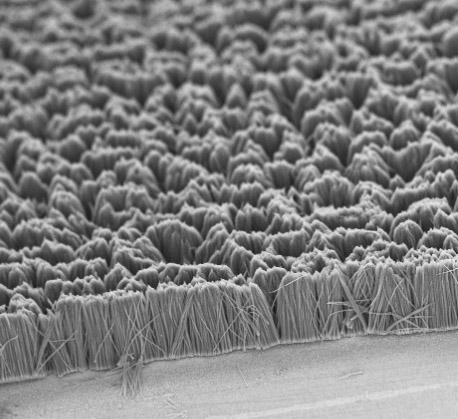
Polymers are usually considered thermal insulators, because the amorphous arrangement of the molecular chains reduces the mean free path of heat-conducting phonons. The most common method to increase thermal conductivity is to draw polymeric fibres, which increases chain alignment and crystallinity, but creates a material that currently has limited thermal applications. Here we show that pure polythiophene nanofibres can have a thermal conductivity up to ~4.4 W m–1 K–1 (more than 20 times higher than the bulk polymer value) while remaining amorphous. This enhancement results from significant molecular chain orientation along the fibre axis that is obtained during electropolymerization using nanoscale templates. Thermal conductivity data suggest that, unlike in drawn crystalline fibres, in our fibres the dominant phonon-scattering process at room temperature is still related to structural disorder. Using vertically aligned arrays of nanofibres, we demonstrate effective heat transfer at critical contacts in electronic devices operating under high-power conditions at 200 °C over numerous cycles.