Advances in Engineering Advances in Engineering features breaking research judged by Advances in Engineering advisory team to be of key importance in the Engineering field. Papers are selected from over 10,000 published each week from most peer reviewed journals.

Journal of Polymer Science Part B: Polymer Physics, Volume 52, Issue 11, pages 737–742, 1 June 2014.
Qinglin Jiang†, Congcong Liu†, Jingkun Xu*, Baoyang Lu, Haijun Song, Hui Shi, Yuanyuan Yao , Long Zhang.
†Jiangxi Key Laboratory of Organic Chemistry, Jiangxi Science and Technology Normal University, Nanchang, China.
†Qinglin Jiang and Congcong Liu contributed equally.
Abstract
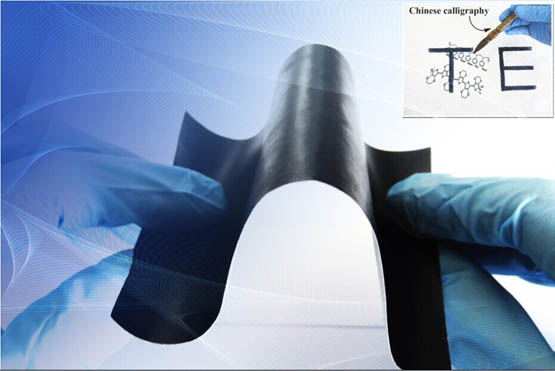
A novel strategy via paper as an effective substrate has been introduced as a thermoelectric material in this work. Free-standing poly(3,4-ethylenedioxythiophene):poly(styrene sulfonate) (PEDOT:PSS)/paper composite films are conveniently prepared by a one-step method of directly writing PEDOT:PSS solution on paper, making the process simple, rapid, and facile. The free-standing composite films display excellent flexibility, light weight, soaking stability in water, and great potential in large-scale production. Improved thermoelectric properties are obtained in PEDOT:PSS/paper composite films, owing to the simultaneously enhanced Seebeck coefficient (30.6 uV K−1) and electrical conductivity, and a low thermal conductivity (0.16 W m−1 K−1) compared with pristine PEDOT:PSS films. The results indicate that paper as an effective substrate is suitable for the preparation of high-performance and flexible thermoelectric materials. © 2014 Wiley Periodicals, Inc. J. Polym. Sci., Part B: Polym. Phys. 2014, 52, 737–742
Copyright © 2014 Wiley Periodicals, Inc.
Additional information
There have been fascinating breakthroughs in organic thermoelectric (TE) materials/composites during the last several years, some of which are already reaching the marketplace. In Xu and Lu’s lab, a simple and economical method was presented for preparing organic TE composites by directly writing poly(3,4-ethylenedioxythiophene):poly(styrene sulfonate) solutions on commercial paper. Improved TE performances, especially doubled Seebeck coefficient, were achieved. The composite film also displayed excellent flexibility, a light weight, and soaking stability in water. This new approach can be employed to develop high-performance organic TE materials and shows great potential in the large-scale production of organic electronics.