Advances in Engineering Advances in Engineering features breaking research judged by Advances in Engineering advisory team to be of key importance in the Engineering field. Papers are selected from over 10,000 published each week from most peer reviewed journals.

physica status solidi (a), Volume 211, Issue 5, pages 971–974, 2014.
J.S. Amaral1,2,*, V. S. Amaral1
- Departamento de Física and CICECO, Universidade de Aveiro, Aveiro, Portugal and
- IFIMUP and IN-Institute of Nanoscience and Nanotechnology, Departamento de Física e Astronomia da Faculdade de Ciências da Universidade do Porto, Porto, Portugal.
Abstract
In striving for mass production of magnetocaloric materials for refrigeration applications, one has to face the fact that these will not be laboratory-grade materials, and will necessarily present (at the very least) composition gradients due to lower quality precursors. One can expect some probable consequences from this, namely that the maximum value of magnetic entropy change (ΔSM) will decrease compared to a pure material, but also some broadening of the ΔSM(T) curves should occur, as observed in some elementary ferromagnets. Some theoretical work has focused on this topic, for second-order phase transition systems via the Landau theory of phase transitions and the molecular mean-field model. Still, these theoretical considerations do not directly apply to first-order phase transition (giant magnetocaloric effect) systems. We here present a study on the effect of disorder on the magnetic and magnetocaloric properties of first-order phase transition systems. We employ the Bean–Rodbell model, and consider disorder to be described by a width of a Curie temperature distribution. We show how disorder effects “smooth” the discontinuities of magnetization and entropy change, and also affect magnetic hysteresis. We show how for sufficiently large disorder, the shape of the magnetic entropy curves approximate the distribution function. We discuss how the magnetic field dependence of magnetic entropy change is affected by disorder, in light of recent reports of “second-order like” dependence of magnetic entropy change on applied magnetic field, for disordered giant magnetocaloric effect La–Fe–Si-based samples.
© 2014 WILEY-VCH Verlag GmbH & Co. KGaA, Weinheim.
Additional Information
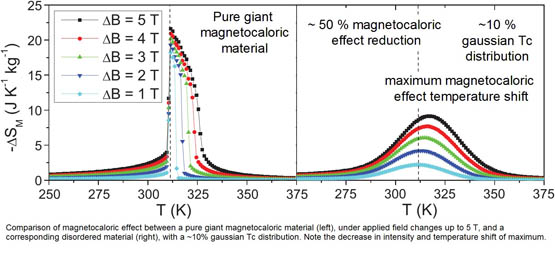
The discovery of the giant magnetocaloric effect in 1997 was instrumental to the recent development of magnetic refrigeration as an efficient and ecologically friendly refrigeration technology. Giant magnetocaloric materials undergo first-order magneto-volume transitions, leading to a typical sharp peak of their magnetocaloric properties, namely isothermal magnetic entropy and adiabatic temperature change, under an applied magnetic field variation. This peak occurs at the Curie temperature (Tc) of the magnetocaloric material. While this holds true for high-quality, laboratory-made materials, real commercial magnetocaloric materials present composition gradients due to lower quality precursors and microstructural defects. This leads to a distribution of Tc values for a given material, and the sharp peaks in the magnetocaloric properties are now broadened. The performance of a “commercial” giant magnetocaloric material then becomes second-order like, with added difficulty to correctly characterize its behavior.
In this work we have performed extensive Bean-Rodbell model calculations of giant magnetocaloric systems, where chemical/structural inhomogeneity is quantified by a width of Tc distributions. We have found that disorder leads to a smoothing of the discontinuities present in isothermal magnetization versus applied field plots, and also a decrease of the irreversibility area, which may be a tuneable parameter for applications. We have shown that a disordered system presents a shift in the magnetic entropy change values with applied field, while the corresponding pure system does not, under typical applied magnetic field change values. The isothermal entropy change behavior of a disordered system becomes similar to its Tc distribution function, which validates the use of a deconvolution approach to infer the disorder present in a given giant magnetocaloric refrigerant material, particularly for materials with a Tc around room temperature or higher.