Advances in Engineering Advances in Engineering features breaking research judged by Advances in Engineering advisory team to be of key importance in the Engineering field. Papers are selected from over 10,000 published each week from most peer reviewed journals.

Textile Research Journal 2013, 0040517513487789.
Jinfeng Wang1, Hairu Long2 , Saeid Soltanian3, Peyman Servati3 and Frank Ko4
- College of Materials and Textiles, Zhejiang Sci-Tech University, China
- College of Textiles, Donghua University, China
- Department of Materials Engineering, University of British Columbia, Canada
- Department of Electrical and Computer Engineering, University of British Columbia, Canada.
Abstract
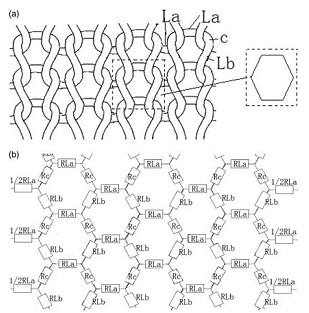
This paper reports the development of a hexagon resistance model to predict electromechanical properties of conductive knitted elastic fabrics, based on the loop structure of a plain weft knitted fabrics. The sensing mechanism is based on the change of the fabric electric resistance responding to deformation caused by an applied load. The relationship between the electric resistance and the load applied to the fabric is analyzed by using a simple fabric structure to identify the key factors such as sensitivity, repeatability and linearity of the fabric gauge. And Holm’s electrical contact theory is used to calculate the relationship between the contact resistance and the contact force in an elastic fabric sensor. The contact load and deformation between two knitting loops are calculated using the classical knitted fabric mechanics model of Kawabata and Popper. It was found that the circuit network is a multiple circuit parallel to the wale direction whereas it is in series along the course direction; the contact resistance of the overlapped yarns in the fabric decreases as a power-law function with the contact force. By simplifying the complex analyses, the application of these models for predicting the conductive deformation behavior of knitted fabric is very practical, especially in the case where the deformation of an elastic knitted fabric is limited in not only one direction, but also in two directions. By designing a suitable fabric structure with this model and an appropriate material, the sensitivity, repeatability and linearity of the sensor are significantly improved. This theoretical study can instruct the design of wearable sensors.