Advances in Engineering Advances in Engineering features breaking research judged by Advances in Engineering advisory team to be of key importance in the Engineering field. Papers are selected from over 10,000 published each week from most peer reviewed journals.

Significance Statement
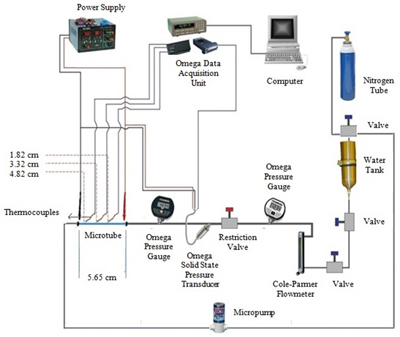
In order to achieve high heat removal rates for micro scale cooling, boiling heat transfer in micro scale is considered as an effective option. The size of systems involving heat transfer is continuously decreasing from mini size to micro size. One of the most effective cooling methods is boiling heat transfer in plain microchannels and microtubes, which might be prone to inherent boiling instabilities. This study provides insight to boiling instability phenomena in microtubes and presents an extensive parametric comparative investigation. Experimental data were obtained from microtubes having 254~µm and 685~ µm inner diameters, which were tested at low mass fluxes (78.9 – 276.3 kg/m2 s) to shed light to potential boiling instability mechanisms. De-ionized water was used as working fluid. The tested microtubes were heated via Joule heating. Suitable conditions for boiling instabilities (low system pressures, low mass fluxes) were chosen to attain boiling instabilities in microtubes. Fine restriction valves were installed to the system for providing inlet restriction . Alongside the experiments without any inlet restriction, experiments were performed with configurations having inlet restrictions, for which pressure drops were 4 and 8 times as much as the pressure drop over the microtube so that boiling instabilities could be suppressed. Temperature and pressure drop fluctuations were recorded with time and then processed for two cases, namely before premature CHF (Critical Heat Flux) conditions and at impending premature Critical Heat Flux conditions. Furthermore, Fast Fourier Transform (FFT) of the recorded data is performed for revealing the frequency correlations of the obtained fluctuations so that the changes in the FFT behavior could be assessed. A significant increase in energy of the side lobes, which are basically the high frequency spectral regions, was obtained from FFT profiles for impending premature Critical Heat Flux conditions implying that FFT could be used as a detection tool for premature Critical Heat Flux.
The proposed technique could be implemented as a protection component for any microfluidic device (such as micro reactors, micro heat sinks) involving boiling to preserve uniformity and functionality of the deviced.
Journal Reference
Applied Thermal Engineering, Volume 65, Issues 1–2, 2014, Pages 575–587.
Alihan Kaya, Mehmed Rafet Özdemir, Mehmet Keskinöz, Ali Koşar.
Mechatronics Engineering Program, Sabancı University, Tuzla, Istanbul 34956, Turkey.
Abstract
In order to achieve high heat removal rates for micro scale cooling, it may be necessary to exploit boiling heat transfer. The size of corresponding heat sinks is continuously decreasing from mini size to micro size, and one of the most practical and extensive cooling methods is boiling heat transfer in plain microchannels and microtubes, which might be limited by inherent boiling instabilities. This study provides useful information about boiling instability phenomena in microtubes and offers a parametric comparative investigation. Experimental data are obtained from microtubes having 254 um and 685 um inner diameters, which were tested at low mass fluxes (78.9–276.3 kg/m2 s) to reveal potential boiling instability mechanisms. De-ionized water was used as working fluid, while microtubes were heated by Joule heating. Configurations prone to boiling instabilities (low system pressures, low mass fluxes) were imposed to observe boiling instabilities in microtubes. Fine restriction valves were introduced to the system for providing flow restriction at the inlet. Alongside the experiments without any inlet restriction, experiments were conducted with configurations having inlet restrictions, where pressure drops over inlet restriction elements were 4 and 8 times as much as pressure drop over the microtube to suppress boiling instabilities. Temperature and pressure drop fluctuation signals were recorded and processed before premature CHF (Critical Heat Flux) conditions and at impending premature Critical Heat Flux conditions. Furthermore, Fast Fourier Transform (FFT) of the recorded data is performed for revealing the frequency correlations of the obtained fluctuations for observing the change in the FFT behavior. A significant rise in energy of the side lobes, which are basically the high frequency spectral regions, was observed from FFT profiles for impending premature CHF conditions implying that FFT could be used as a detection tool for premature Critical Heat Flux.