Advances in Engineering Advances in Engineering features breaking research judged by Advances in Engineering advisory team to be of key importance in the Engineering field. Papers are selected from over 10,000 published each week from most peer reviewed journals.

Significance Statement
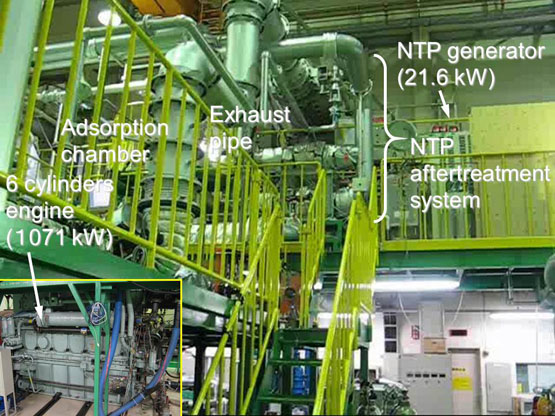
An adsorption-plasma combined NOx aftertreatment system for marine diesel exhaust gas is developed. An experiment using a pilot-scale aftertreatment system for a marine diesel engine (6DK-20e, Daihatsu Diesel MFG. Co. Ltd.) with an output power of 1 MW has been carried out using a NTP (nonthermal plasma) generator with a power of 21.6 kW. This system does not use any rare or precious metal catalysts, harmful ammonia, or urea solution. Therefore, this method has significant advantages over conventional exhaust gas treatments such as the marine SCR (selective catalytic reduction) method, which requires a urea solution storage tank inside the ship.
Journal Reference
Plasma Chemistry and Plasma Processing, 2014, Volume 34, Issue 1, pp 65-81.
Takuya Kuwahara (1), Keiichiro Yoshida (3) , Tomoyuki Kuroki (2), Kenichi Hanamoto (4) , Kazutoshi Sato (4), Masaaki Okubo (2)
[expand title=”Show Affiliations”]1. Department of Products Engineering and Environmental Management, Nippon Institute of Technology, 4-1 Gakuendai, Miyashiro-machi, Minamisaitama, Saitama, 345-8501, Japan and
2. Department of Electrical and Electronic Systems Engineering, Osaka Institute of Technology, 5-16-1 Omiya, Asahi-ku, Osaka, 535-8585, Japan and
3. Department of Mechanical Engineering, Osaka Prefecture University, 1-1 Gakuen-cho, Naka-ku, Sakai, 599-8531, Japan and
4. Moriyama Division, Daihatsu Diesel MFG. Co. Ltd., 45 Amura-cho, Moriyama, Shiga, 524-0035, Japan.
[/expand]
Abstract
Regulations governing marine diesel engine NOx emissions have recently become more stringent. As it is difficult to fulfill these requirements by combustion improvements alone, effective aftertreatment technologies are needed to achieve efficient NOx reductions. In this study, we develop an effective NOx-reduction aftertreatment system for a marine diesel engine that employs combined nonthermal plasma (NTP) and adsorption. Compared with selective catalytic reduction, the proposed technology offers the advantages of not requiring a urea solution or harmful heavy-metal catalysts and low operating temperatures of less than 150 °C. The NOx reduction comprises repeated adsorption and desorption flow processes using NTP combined with NOx adsorbents made of MnOx–CuO. High concentrations of NOx are treated by NTP after NOx adsorption and desorption, and this aftertreatment system demonstrates excellent energy efficiencies of 161 g(NO2)/kWh, which fulfills the most recent International Maritime Organization emission NOx standards in the Tier II–III regulations for 2016 and requires only 4.3 % of the engine output power.