Advances in Engineering Advances in Engineering features breaking research judged by Advances in Engineering advisory team to be of key importance in the Engineering field. Papers are selected from over 10,000 published each week from most peer reviewed journals.

Significance Statement
At present, cold-formed steel members, or beams welded from thin sheet metals with open sections are widely used in metal building construction, and also in machinery, shipbuilding and aviation industries. These members are characterized by small thickness of walls and relatively low torsional rigidity. Bimoments caused by warping torsion can be essential components of section load for this class of thin-walled members.
Up to now, calculations for thin-walled members subjected to warping torsion were performed using the Vlasov theory. That is reflected in modern structural design codes for cold-formed steel members, where the possibility of the local buckling of the thin-walled section under warping torsion is disregarded.
In the study, it is theoretically confirmed that thin-walled bars with open sections, subjected to warping torsion, can undergo local buckling when no other loads act on them. The “local critical bimoment” (Bcr) which produces local buckling of a thin-walled bar, is defined. That constitutes a limit of the Vlasov theory validity. The study presents the method of theoretical determination of critical warping stresses (sLω,cr) from the condition of the local buckling of thin-walled bars with any open cross-section built from flat walls (thin plates). It is shown that two local critical bimoments are present in bars with asymmetrical sections depending on the sense of the torsional load. Those bimoments differ in their absolute value, the “right” one (Bcr,R) is greater, and the “left” one (Bcr,L) is smaller. The way of the arrangement of the section in relation to the sense of torsional load determines the occurrence of a “greater” or “smaller” local buckling resistance of a thin-walled bar in this case.
The calculation of the warping torsion in thin-walled bars with a flexible cross-section contour on the basis of the Vlasov theory in the whole elastic range (-By<B<By, where: By – first yield bimoment) may lead to considerable errors caused by local buckling. The Vlasov theory is useful in the analysis of stress distribution in the cross-section of a thin-walled bar under warping torsion which causes the bimoment to be contained in the range of Bcr,R<B<Bcr,L. After the critical load is exceeded, a thin-walled bar undergoes local buckling and the basic assumption of the Vlasov theory [1] concerning the rigid cross-section contour loses its validity. Such a situation may lead to an erroneous assessment of the thin-walled structure load bearing capacity and have a negative effect on the structure reliability.
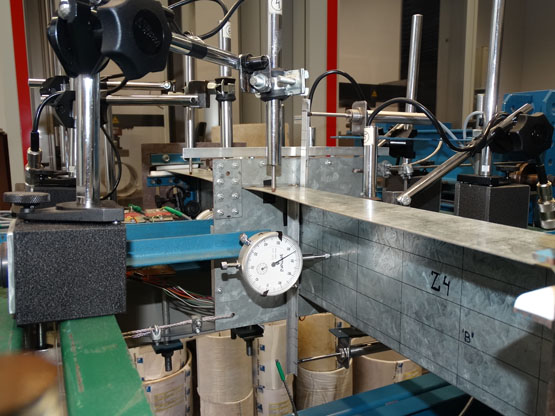
Figure legend: Local buckling of the thin-walled member subjected to warping torsion.
Thin-Walled Structures, Volume 76, 2014, Pages 42–55. Andrzej Szychowski.
Faculty of Civil Engineering and Architecture, Kielce University of Technology, Al. Tysiąclecia Państwa Polskiego 7, 25-314 Kielce, Poland.
Abstract
Results of a theoretical analysis of the local buckling in thin-walled bars with open cross-section subjected to warping torsion are presented. The local critical bimoment, which generates local buckling of a thin-walled bar and constitutes the limit of the applicability of the classical Vlasov theory, is defined. A method of determining local critical bimoment on the basis of critical warping stress is developed. It is shown that there are two different local critical bimoments with regard to absolute value for bars with an unsymmetrical cross-section depending on the sense of torsion load (sign of bimoment). However, for bars with bisymmetrical and monosymmetrical sections, the determined absolute values of local critical bimoments are equal to each other, irrespective of the sense of torsional load. Critical warping stresses, local critical bimoments and local buckling modes for selected cases of thin-walled bars with open cross-section are determined.