Advances in Engineering Advances in Engineering features breaking research judged by Advances in Engineering advisory team to be of key importance in the Engineering field. Papers are selected from over 10,000 published each week from most peer reviewed journals.

Nanotechnology Volume 26 Number 4, 2015. Jirachai Getpreecharsawas1, James L McGrath2 and David A Borkholder1,2
1 Microsystems Engineering, Rochester Institute of Technology, Rochester, New York 14623, USA
2 Department of Biomedical Engineering, University of Rochester, Rochester, New York 14627, USA
Abstract
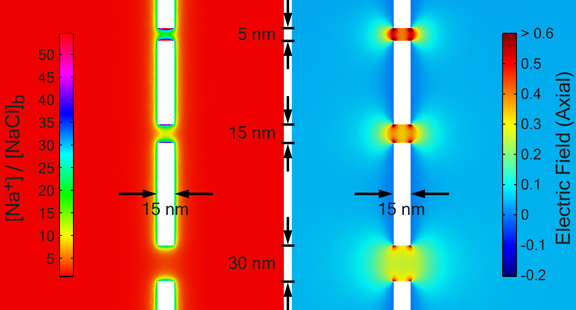
Here we show that the electric field inside ultrathin membranes is weaker than conventional theory would predict, and that the reduced field is predictive of measured electroosmotic flow rates. Our theoretical analysis shows that the electric field inside a charged nanopore is affected by end effects and dependent on the Dukhin number Du when the pore length-to-diameter aspect ratio λ is less than 80 for Du 1 or 300 for Du 1. The electric field follows an unconventional scaling law; it no longer scales uniformly with the thickness of ultrathin membrane, but with the local value of λ for each nanopore